What Soffit and Fascia Do, and Why Homeowners Ignore the Damage
Ask what soffit and fascia do, and most homeowners will shrug. These two boards run along the entire edge of your roof, yet they get less attention than almost any other part of the house. That is a problem, because when they rot, the damage spreads quietly into your rafters, your attic, and eventually your walls. Here in Orlando, where summer thunderstorms hammer rooflines for months at a time, ignored soffit and fascia damage is one of the most common things we find hiding behind a failing gutter. A soffit vs fascia comparison reveals how these two boards protect your roof edge differently, yet fail together.
This article compares the two boards side by side: what each one does, how each one fails, what repair involves for each, and why the smartest fix usually treats them, and your gutters, as one system instead of three separate projects.
What Soffit and Fascia Do for Homeowners
Soffit and fascia protect the edge of your roof from water, pests, and heat. The fascia is the vertical board that runs along the roofline and holds your gutters. The soffit is the horizontal panel underneath the overhang that vents your attic and seals out animals. Together they close off the gap between your roof and your walls.
If you have never thought about them, you are not alone. They sit above eye level, they rarely fail all at once, and the early signs look cosmetic. A little peeling paint. A soft spot you only notice when a gutter cleaner leans a ladder against it. Most people file it under "someday."
However, that gap between the roof and the wall is exactly where Central Florida weather does its worst work. Wind-driven rain, humidity, and heat cycle through that edge all summer. Once water gets past the fascia, it does not stop there.
Fascia: The Board That Holds Everything Up
Start with the fascia, because it carries the most load. Fascia is the long, flat board nailed to the ends of your roof trusses. Your gutters hang from it. Your drip edge sits on top of it. It is the last line of defense between runoff and the wooden structure of your roof.
How Fascia Fails: What Causes Soffit and Fascia Damage
Fascia almost always fails from water, and the water usually comes from one of two places. First, a home with no gutters at all lets rain run straight off the roof edge and down the face of the board, soaking it season after season until it rots. Second, old or clogged gutters overflow and push water backward, behind the gutter and against the fascia, where it sits and never dries.
If you are the homeowner whose gutters waterfall over the sides every time it rains hard, pay attention to that second one. Every overflow event is also a fascia-soaking event. You might call it a gutter problem. The wood behind the gutter experiences it as a rot problem.
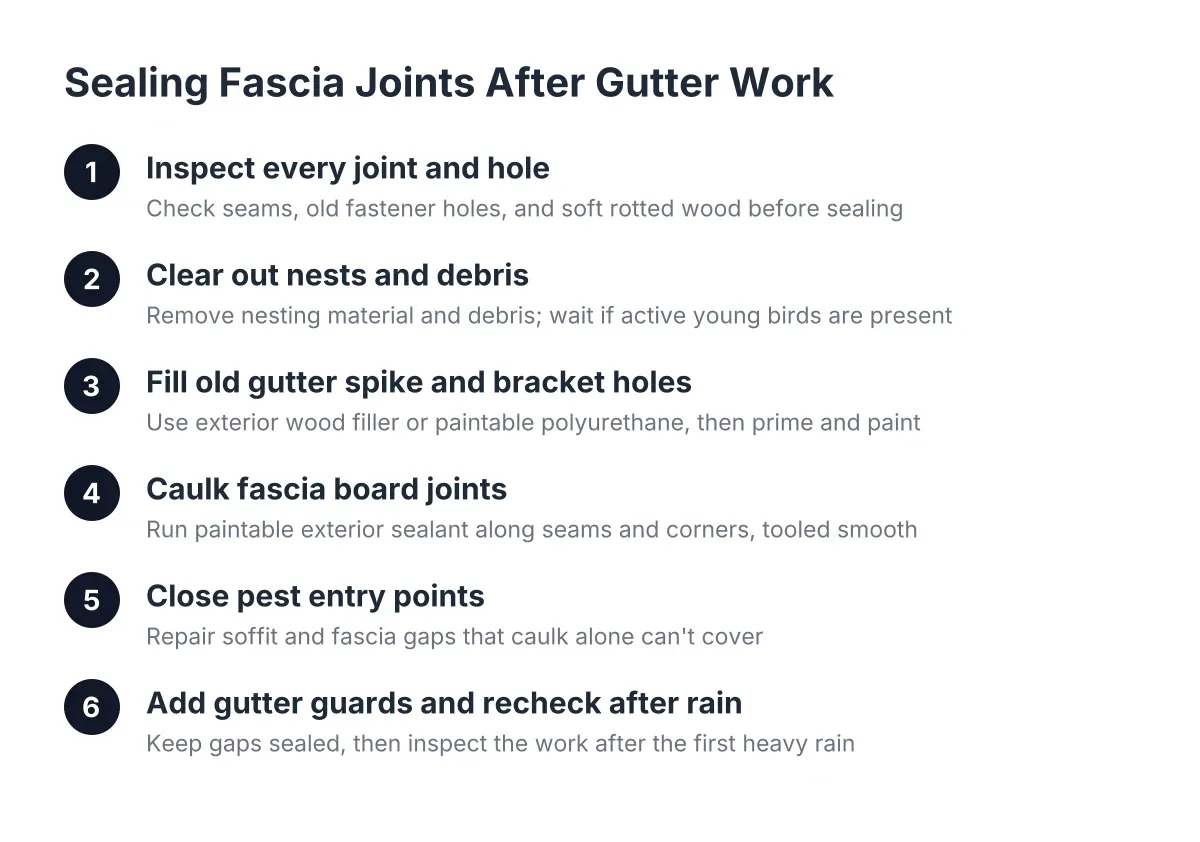
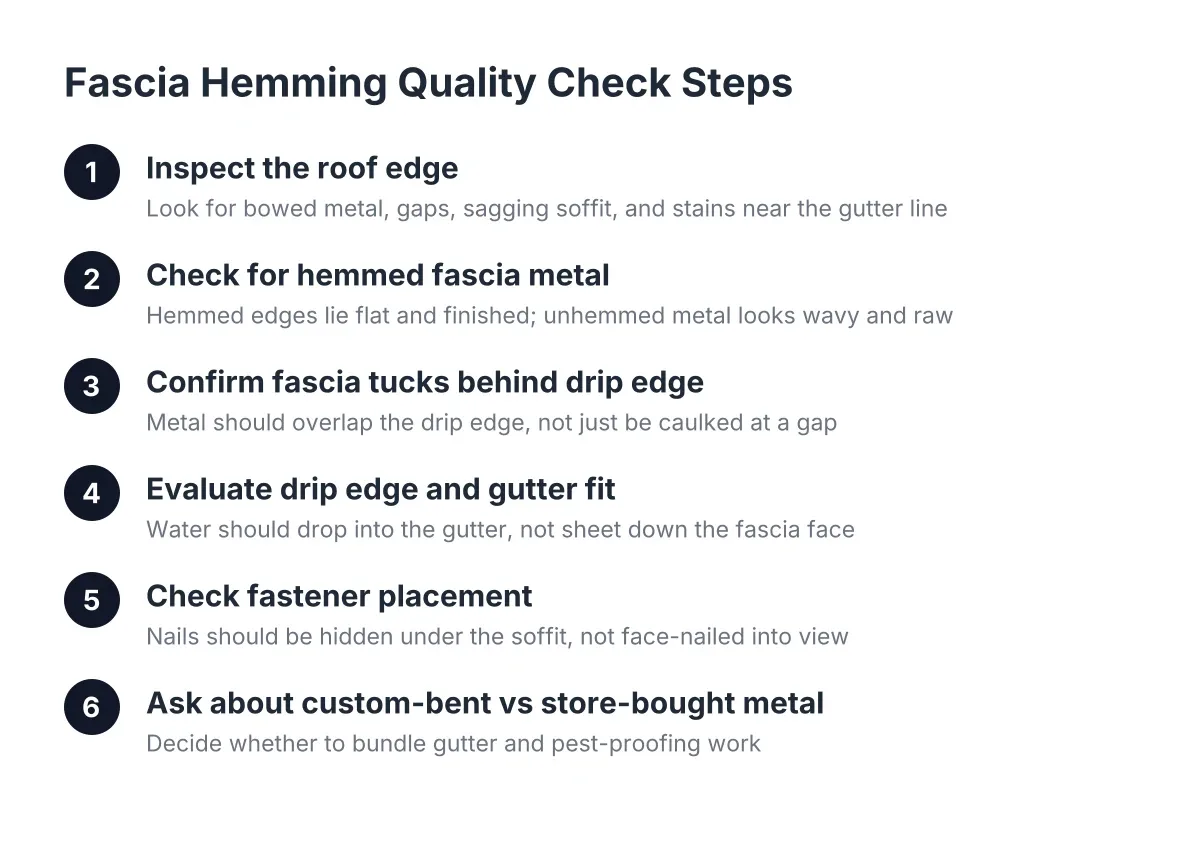
Another cause gets less attention: installation shortcuts. Fascia metal that was face-nailed everywhere along its length, instead of fastened up underneath through the soffit, leaves nail holes across the exposed face. Each hole is a tiny entry point for water. Done right, face fastening belongs only at seams, where it secures overlapping joints.
What fascia roof repair involves
Fascia roof repair means pulling the gutter off, removing the rotted board, checking the rafter tails behind it, and installing new material. If the rot reached the rafter ends, the job grows. That is the real cost of waiting: a board swap becomes structural carpentry.
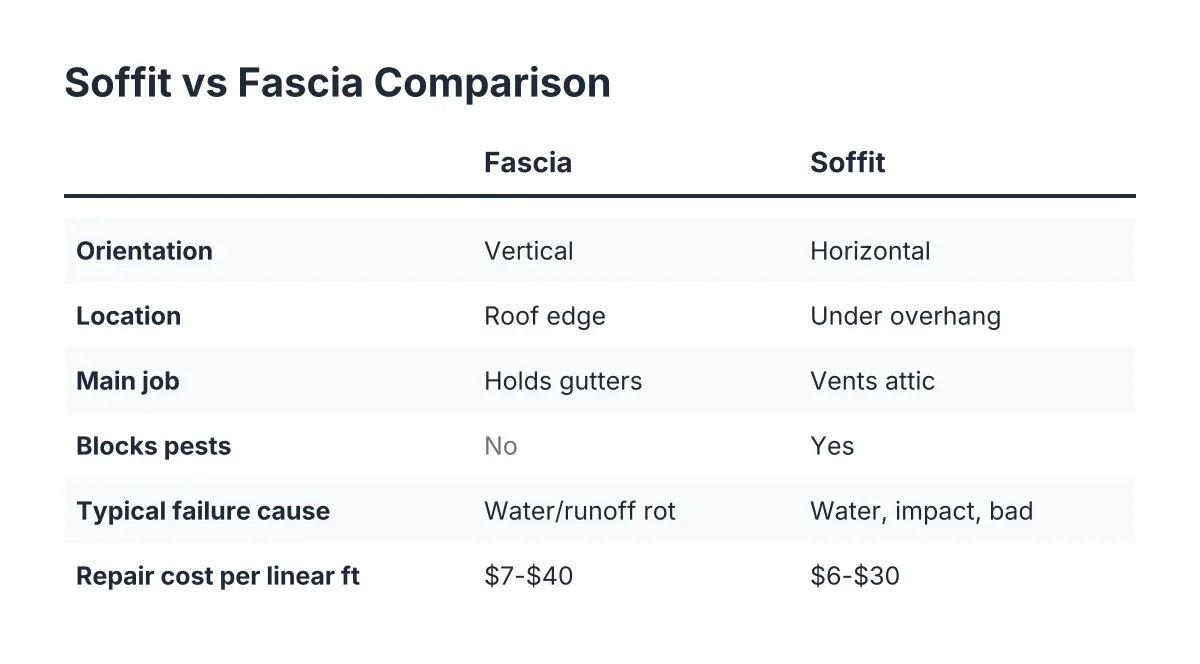
According to This Old House, fascia board replacement typically runs $7 to $40 per linear foot depending on materials, length, and local labor rates. The spread is wide because the hidden condition of the wood behind the board drives the price more than the board itself.
Soffit: The Panel Doing Quiet Work Overhead
Now the soffit. It gets even less respect than the fascia because it faces the ground and nothing hangs from it. That does not make it optional.
Soffit panels close off the underside of your roof overhang. Vented soffit lets your attic breathe, pulling in outside air so heat and moisture do not build up under the roof deck. In an Orlando summer, that ventilation matters for your attic temperature and the life of your roof. Soffit also keeps out squirrels, rats, birds, and wasps, all of which treat an open overhang as an invitation.
How Soffit Fails: Soffit and Fascia Comparison of Damage Patterns
Soffit usually fails in one of three ways:
- Water from above. A leaking roof edge or an overflowing gutter sends water into the overhang, and the soffit panel sags, stains, or rots from the back side.
- Impact and age. Storms, ladders, and decades of sun crack or loosen panels until they droop or fall out.
- Poor original installation. Panels that were face-fastened instead of slid into the channel at the fascia and secured properly tend to pull loose over time.
That last point surprises people. A share of soffit and fascia repair calls trace back to how the materials went on in the first place, not to any single storm. This matters for builders too: a renovation with new rooflines deserves soffit and fascia installed to spec, because shortcuts at this stage become the homeowner's service calls five years later.
What soffit repair involves
Soffit repair ranges from re-securing a loose panel to replacing whole runs and the framing behind them. According to This Old House, soffit replacement runs $6 to $30 per linear foot, averaging about $17 per linear foot. As with fascia, the condition hiding behind the panel is what moves the number.
Side by Side: How the Two Boards Compare
Here is the comparison in plain terms.
Location. Fascia is vertical, facing out along the roof edge. Soffit is horizontal, facing down under the overhang.
Job. Fascia carries the gutters and blocks water at the roof edge. Soffit vents the attic and seals the overhang against pests.
Failure mode. Fascia rots from runoff and gutter overflow. Soffit sags and rots from water intrusion above it, or pulls loose from poor fastening.
Early warning signs. For fascia: peeling paint along the roofline, gutters pulling away from the house, visible soft or dark wood behind the gutter. For soffit: sagging or stained panels, gaps at the edges, animal noise in the attic.
Repair cost drivers. For both, the drivers are the same: linear footage, material choice, how much hidden rot the crew finds, and roofline complexity. According to Angi, soffit and fascia repairs range from $300 to $7,200 depending on materials and damage level, with dry rot repairs running $500 to $4,000. HomeAdvisor puts professional fascia and soffit work between $1,050 and $3,300 for a typical home.
Which fails first? Usually the fascia, because the gutters load it with water every storm. But they rarely fail alone, which brings us to the real point.
Why Homeowners Ignore Soffit and Fascia Damage
Homeowners ignore soffit and fascia damage because it hides in plain sight, fails slowly, and masquerades as a gutter problem. The boards sit above eye level, the rot starts behind the gutter where no one looks, and the visible symptom, overflowing water, points everyone at cleaning instead of the roofline itself.
Think about the chronic-overflow pattern. Suppose a homeowner in an older Orlando neighborhood has paid for gutter cleaning three times this year, and the gutters still pour over the sides in every heavy storm. In that scenario, the cleanings treat a symptom. The likely causes are undersized gutters, bad slope, or poorly placed downspouts, and every overflow has been soaking the fascia the whole time. By the time someone finally pulls the gutter off, the board behind it crumbles in their hand.
Neglect is common with gutters generally. This Old House's 2025 gutters survey found 44% of homeowners nationwide never clean their gutters. Each skipped cleaning is more standing water against the fascia.
There is also a trust problem. Many homeowners worry that whoever shows up will sell them the easy fix, another cleaning, instead of diagnosing whether the real issue is gutter size, slope, downspout placement, or rotted fascia that can no longer hold the gutter at the right pitch. That worry is fair. The honest answer requires looking at the whole edge of the roof, not just scooping leaves.
Why Soffit, Fascia, and Gutters Fail Together
These three components fail together because they share the same water and the same weather. The gutter overflows, the fascia rots, the soffit behind it soaks, and the sag in the rotted fascia makes the gutter pitch worse, which causes more overflow. It is a loop, and patching one piece at a time rarely breaks it.
Therefore, the fix that lasts is usually a bundled one:
- Diagnose the overflow: clog, slope, undersized gutters, or downspout placement.
- Open up the roofline and replace rotted fascia and damaged soffit, checking rafter tails while everything is exposed.
- Install new seamless gutters sized and pitched for the roof, hung on sound wood.
- Add gutter screens if nearby trees keep feeding the clogs, and extend downspouts so water lands away from the foundation.
Bundling fascia and soffit repair with gutter installation also means one crew, one ladder setup, and one accountable party for the whole roof edge. Hiring a carpenter for the boards and a separate gutter company later invites finger-pointing if anything leaks. For builders and remodelers finishing new rooflines, the same logic holds: one sub who handles soffit, fascia, and seamless gutters together keeps the schedule tight and the details consistent across every house.
One trade-off worth naming: replacing more than the bare minimum costs more up front. If your fascia is rotted in one eight-foot stretch and the rest is sound, a targeted repair makes sense. If rot shows up in several spots and the gutters are decades old, piecemeal repairs usually cost more over five years than doing the roofline once, correctly.
How to Choose Your Next Step
Start with a diagnosis, not a service. Before you pay for another cleaning or sign off on new gutters, get someone on a ladder to answer four questions:
- Is the overflow caused by clogs, slope, undersized gutters, or downspout placement?
- Is the fascia behind the gutters solid enough to hold new ones at the correct pitch?
- Is the soffit intact, vented, and sealed against pests?
- What is driving the cost: footage, material, hidden rot, or roofline complexity?
If the wood is sound and the gutters are just undersized, you may only need new seamless gutters and better downspouts. If the fascia is soft, replace it before hanging anything on it; new gutters on rotted wood is money wasted. And if you see sagging soffit, animal activity, or rot in multiple places, treat the roofline as one project.
What soffit and fascia do for homeowners is simple: they guard the most vulnerable edge of the house. The repair is straightforward when caught early and expensive when ignored. In 2026, with another Central Florida storm season always on the calendar, the cheapest time to look at your roofline is before the next heavy rain, not after it. When rot may have reached the rafters, bring in a professional rather than guessing from the ground; structural damage at the roof edge is not a judgment call to make from a photo.
If you need soffit and fascia repair, Orlando Gutter Installers can help.
Prefer to talk it through? Call (689) 399-8982 — a quick call is usually the fastest way to get a straight answer for your situation.