Why Soffit and Fascia Repair Cannot Wait in Florida Weather: A Step-by-Step Guide
If a storm just tore up your roofline, here is the honest truth: storm damaged soffit fascia repair cannot sit on a to-do list in Central Florida. Our summer thunderstorms come in waves, and every new downpour pushes water deeper into exposed wood at the roof edge. What starts as a loose fascia board after one storm can become rotted framing, moldy attic insulation, and a gutter that has nothing solid to hang from by the end of the season.
This guide walks you through exactly what to do, step by step, from the first hour after the storm to the finished repair. It is written for the homeowner scrambling after damage, but the same sequence applies if you are a builder coordinating roofline work across several Orlando projects.
Step 1: Document the Damage Before You Touch Anything
First, take photos and video of everything from the ground. Walk the full perimeter of the house and capture wide shots of each side, then close-ups of hanging gutters, split fascia boards, sagging soffit panels, and any water stains on the siding below.
Why does soffit and fascia repair work start with a camera instead of a ladder? Because if insurance ends up covering any of it, your claim lives or dies on what you can show the adjuster. Photos taken before any tarping or temporary fixes carry more weight than photos taken after.
Capture these specifics:
- Date-stamped wide shots of each roofline, even sides that look fine
- Close-ups of detached or dented gutters and downspouts
- Any fascia boards that are cracked, pulled away, or missing
- Soffit panels that are sagging, punctured, or blown out
- Water running down siding or pooling at the foundation
- Fallen branches or debris still resting on the roofline
In addition, save any photos you have of the house from before the storm. Listing photos, holiday pictures, anything that shows the roofline intact helps establish what changed.
Step 2: Stop Active Water Intrusion, Safely
Next, limit how much more water gets in before a crew arrives. The soffit is the underside of your roof overhang, and the fascia is the vertical board the gutters attach to. Together they seal the gap between your roof edge and your walls. When either one is open, rain and wind-driven water have a direct path into the attic. Storm damaged soffit and fascia create vulnerability that spreads damage deeper with each rainfall.
From the ground or a stable step ladder, you can do a few safe things:
- Move downspout extensions so water drains away from the damaged section.
- Clear debris out of reachable gutter sections so water is not spilling over the break.
- Tack a tarp over a gaping soffit opening if you can reach it without getting on the roof.
However, do not climb onto the roof, and do not try to pry off damaged boards yourself. Storm-loosened fascia can let go without warning, and a gutter full of water is heavier than it looks. If the damage is above one story, or power lines are anywhere near the roofline, stop and wait for a professional.
Step 3: Call Your Insurer and a Roofline Contractor the Same Day
Therefore, make two calls before the next rain band moves through. Call your insurance company to open a claim, and call a contractor who handles soffit and fascia repair along with gutter repair. In Orlando, roofline damage almost never hits just one component; the gutters, fascia, and soffit fail together because they take the same wind and water.
When you call a contractor, ask direct questions and expect plain answers:
- What drives the cost up or down on a job like mine?
- Will you give me a written scope with photos I can hand to my adjuster?
- Is this a repair or a replacement, and how will you decide?
- Can one crew handle the fascia, the soffit, and the gutters together?
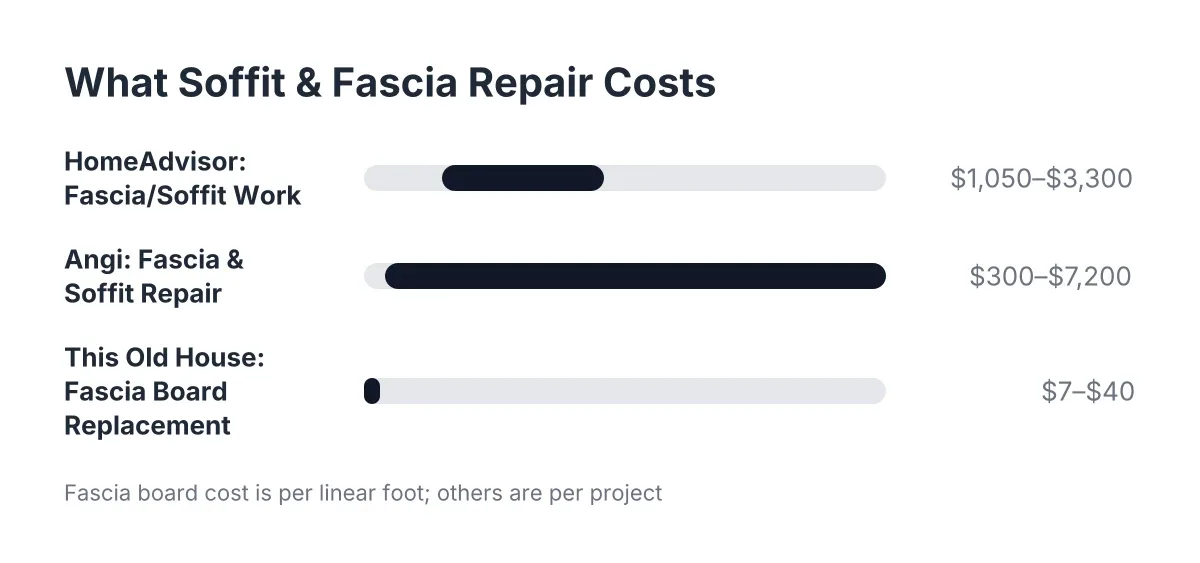
A straight-talking contractor explains cost factors before anyone sets foot on the roof: how many linear feet are damaged, what material the fascia and soffit are, how complex the roofline is, and whether the wood underneath is sound. For a rough national frame of reference, HomeAdvisor puts professional fascia and soffit work between $1,050 and $3,300 for a home, and Angi reports a wider span of $300 to $7,200 depending on materials and how far the damage has spread. Your number depends on your roofline, which is exactly why the written scope matters.
Step 4: Repair vs. Replacement After Storm Damaged Soffit and Fascia
Once a contractor is on site, the central question is whether the boards can be repaired or need replacement. The honest answer comes from probing the wood, not just looking at it. Paint can hide rot; a screwdriver pressed into the fascia cannot.
Why Storm Damaged Soffit and Fascia Cannot Be Patched Later
Can a damaged soffit or fascia board wait a few weeks and still be patched? Usually not in Florida. Wet wood that stays wet through repeated storms moves from surface damage to structural rot fast, and rotted fascia will not hold gutter hangers or new fasteners. What would have been a one-day board swap becomes replacement of the board, sections of soffit, and sometimes the sub-fascia behind it.
Here is the decision logic a good crew applies:
- Repair makes sense when damage is limited to a short run, the wood is dry and solid behind the damaged face, and the drip edge and roof sheathing above are intact.
- Replacement makes sense when rot has spread along the board, fasteners no longer bite, the soffit panels are sagging from trapped moisture, or the damage sits at a seam or corner where water collects.
As a result, pushing the decision off usually pushes you into the replacement column. This Old House lists fascia board replacement at $7 to $40 per linear foot and soffit replacement at $6 to $30 per linear foot, averaging around $17. Every week of exposure tends to add linear feet to that count.
Step 5: Bundle the Gutter Work Into the Same Visit
Since the fascia is what your gutters mount to, fix both in one pass. Hiring one trade for the boards and another for the gutters means two schedules, two trips, and a gutter installer hanging new seamless gutters on wood they did not inspect. One crew handling fascia and soffit repair plus the gutter installation closes that gap.
There is a second reason the bundle matters: missing or failed gutters are a common cause of fascia rot in the first place. Without gutters catching runoff, every storm sends water sheeting down the roof edge and soaking the fascia. Repairing the boards and leaving the gutters off just restarts the rot clock.
For example, suppose a homeowner near downtown Orlando has 20 feet of fascia split by a fallen oak limb, with the gutter section dangling below it. In that scenario, a typical single-crew sequence looks like this: remove the damaged gutter run, replace the split fascia and any soft soffit panels, confirm the new fascia tucks up behind the drip edge so water cannot get behind it, then hang a new seamless gutter run on the fresh, solid board. One visit, one invoice, one set of photos for the adjuster.
Step 6: Verify the Details That Keep It From Failing Again
Finally, inspect the finished work before the crew leaves. Much of the soffit and fascia damage contractors see traces back to shortcuts in the original installation, not the storm itself. A storm just finds the weak points first.
Check for these marks of a job done right:
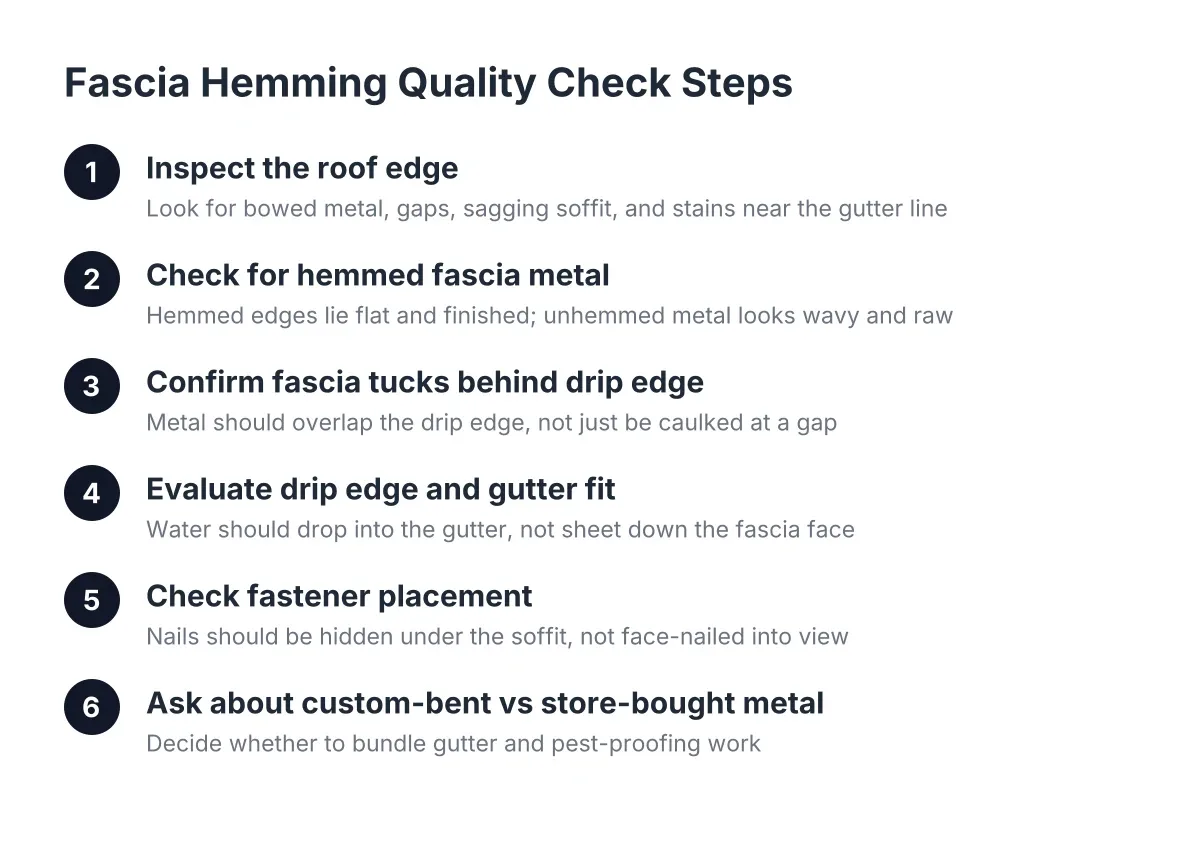
- Fascia metal runs up behind the drip edge. The drip edge exists to tuck the fascia underneath it, shielding the top edge from water and holding it tight to the framing.
- No face nails scattered across the fascia. Fasteners belong underneath, driven up through the soffit; face nailing is appropriate only at seams where boards overlap.
- Soffit panels sit in their channel. Panels should slide into the J-channel at the fascia and be secured from behind, not screwed through the face.
- Hemmed edges on bent fascia metal. Folded top and bottom edges add rigidity and a cleaner line; crews in a hurry skip this.
- Gutters pitched toward the downspouts, with downspout extensions carrying water away from the slab.
If your contractor cannot explain these details in plain language, that tells you something. The crew that rushes the fascia today is the crew you call back after the next storm.
Step 7: Keep the Paper Trail for Insurance and Resale
After the work is done, file everything in one folder: your before photos, the written scope, the invoice, and after photos of the finished roofline. For an insurance claim, this is the package your adjuster needs. For a future sale, it shows the roofline was professionally repaired, not patched.
One honest caveat: not every storm-damage claim gets approved, and a contractor cannot promise what your policy covers. Pre-existing rot from years of missing gutters is often treated differently than fresh wind damage, which is one more reason the dated photos from Step 1 matter.
The Bottom Line for Orlando Rooflines
In a drier climate, a damaged roof edge might limp along for a season. Here, with thunderstorms stacking up through the summer, repair of the soffit and fascia cannot be the project you get to in the fall. Document the damage today, make both calls, get a straight repair-vs-replace answer, and have one crew restore the boards and the gutters together. That sequence turns a scramble into a fixed roofline before the next storm tests it.
If you need soffit and fascia repair, Orlando Gutter Installers can help.
Prefer to talk it through? Call (689) 399-8982 — a quick call is usually the fastest way to get a straight answer for your situation.