Storm-Damaged Gutters in Orlando: How to Get Gutter Installation Done Fast
A storm rips through Orlando, your gutters end up hanging off the roofline or lying in the yard, and now water pours straight down your siding every time it rains. You have already decided to hire someone. The question now is how to get the storm gutter replacement process scheduled fast, documented right for insurance, and done so the new system holds up through the next thunderstorm season. This guide walks you through the process step by step, from the first hour after the storm to the final hose test on your new gutters and downspouts.
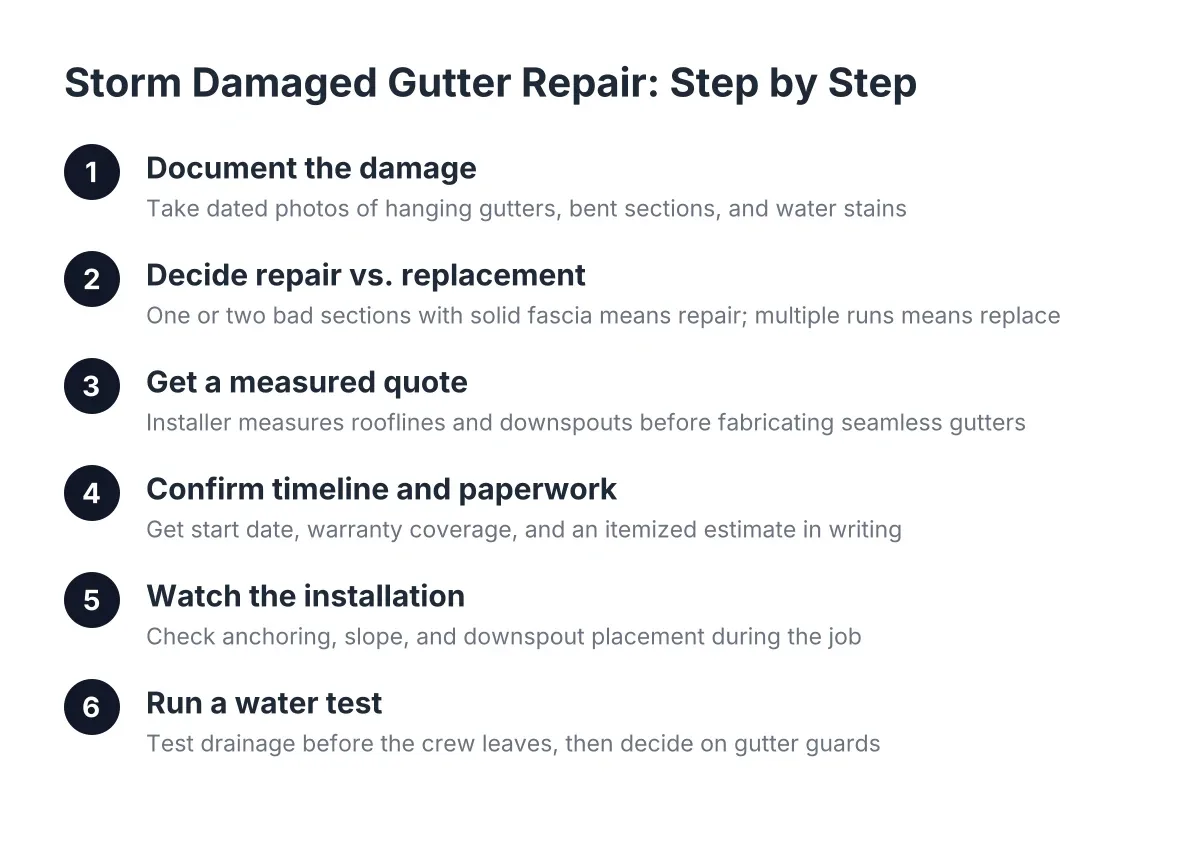
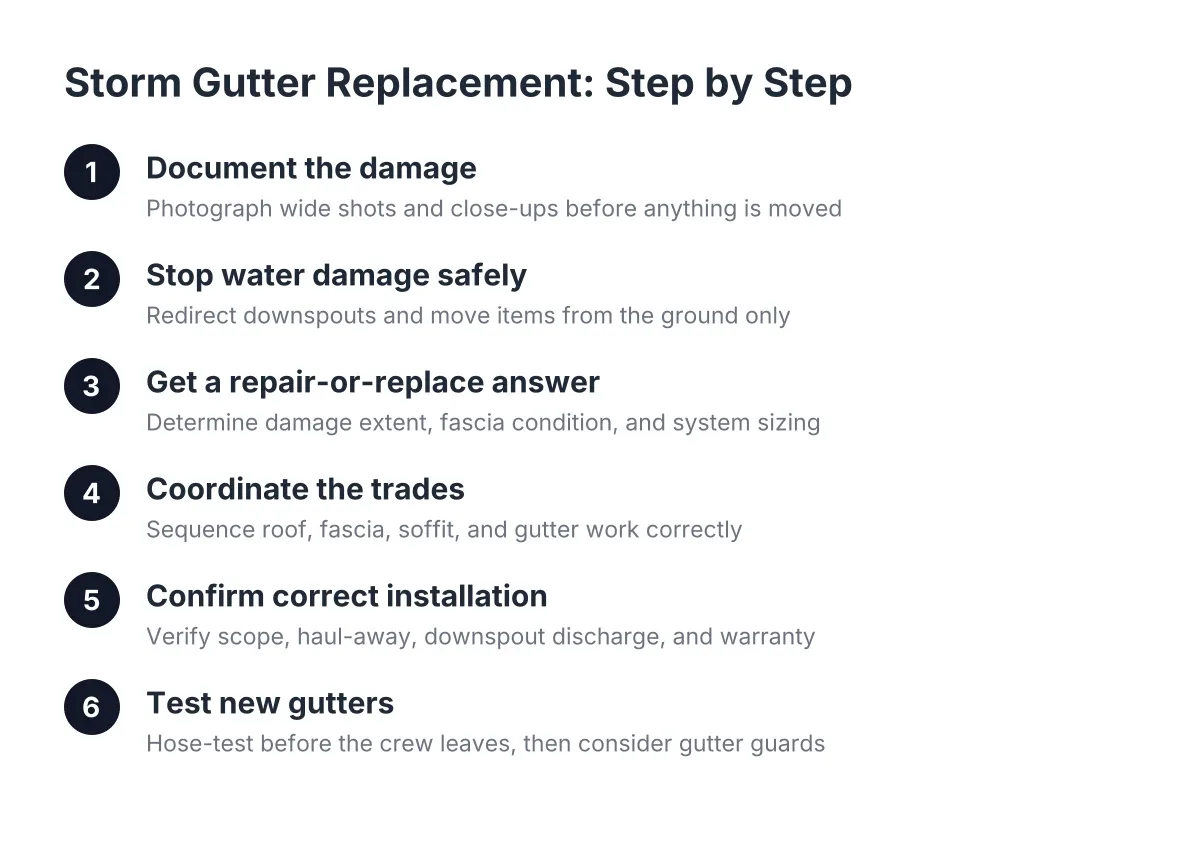
Step 1: Document the Damage Before Anything Gets Moved
Grab your phone and take photos before anyone touches the damage. Shoot wide shots of each affected side of the house, then close-ups of torn gutters, bent hangers, cracked fascia, and any soffit panels that pulled loose. Photograph water staining on siding or pooling near the foundation too, since that shows the damage is causing ongoing harm.
Insurance adjusters want to see the damage as the storm left it. If a section of gutter is in the yard, photograph it where it landed before you drag it to the curb. Note the date and time of the storm in your notes app so the timeline is easy to reconstruct later.
In addition, check your policy or call your agent to ask whether wind damage to gutters, soffit, and fascia is covered. A gutter company can give you a detailed written scope and photos that support a claim, but the claim itself is between you and your insurer. If a tree hit the roof itself, get a roofer involved first, because gutters cannot go on until the roof edge is sound.
Step 2: Stop the Water Damage You Can Safely Stop
Next, deal with anything actively making things worse, from the ground only. If a gutter section is dangling by one hanger, do not climb up and wrestle it down. A loose 20-foot run of aluminum in gusty weather is dangerous, and ladder falls are the biggest risk in this whole process. Leave roof-edge work to people who do it daily.
What you can do safely:
- Move downspout extensions or splash blocks so any water still draining lands away from the foundation.
- Pull patio furniture, grills, and planters out from under hanging sections.
- Lay a tarp or gravel bags where water is sheeting off the roof edge onto bare soil near the house.
- Shut off exterior outlets near water intrusion points if water is running down that wall.
These small moves buy you time. They will not fix anything, but they keep a torn gutter from turning into a flooded flower bed or a washed-out foundation corner while you line up the repair.
Step 3: Get a Repair-or-Replace Answer, Not Just a Visit
When you call around for storm damage gutter repair in Orlando, push past "we'll come take a look." Ask each company what information they need to give you a real answer. A straight-talking installer can tell you a lot from your photos and a few measurements: roughly how many linear feet are damaged, whether the fascia behind the gutter looks rotted or split, and whether the rest of the run is worth saving.
The repair-versus-replace call usually comes down to three things:
- How much of the run is damaged. One crushed 10-foot section on an otherwise solid run is a repair. Multiple torn sections, or seamed gutters that were already leaking at the joints, usually point to full seamless gutter replacement.
- The condition of the soffit and fascia. Gutters attach to the fascia board. If the storm exposed rot, or the hangers ripped out because the wood was soft, fascia replacement has to happen before new gutters go up. Skipping this step means the new gutters pull loose in the next big blow.
- Age and sizing of the existing system. If your gutters were undersized for Central Florida's summer downpours to begin with, replacing like-for-like just rebuilds the old problem. This is the moment to upsize.
Be wary of anyone who refuses to discuss cost factors before a site visit. You will not get an exact number over the phone, and you should not, since nobody has measured your roofline yet. But a company should explain what drives the price: total gutter length, material, how many corners and downspouts your roofline needs, and whether soffit and fascia work is part of the job. For broad context, Angi reports gutter installation averages $4 to $40 per linear foot depending on material and gutter type, and Modernize puts seamless gutters at $8 to $28 per linear foot on average in the U.S. Treat those as national reference ranges, not a quote for your house.
Step 4: Understanding the Storm Gutter Replacement Process and Coordinating the Trades
Once you pick a company, lock in the sequence. Order matters after a storm, and getting it wrong wastes money.
If your roof needs replacement, the roof goes first. Installing new gutters before a roof tear-off means paying to remove and re-hang them, so a combined timeline saves real labor cost. However, if the roof is fine and only the gutters, soffit, and fascia took the hit, the gutter crew can handle all of it in one visit: fascia replacement, soffit repair, then new seamless gutters over the fresh wood.
Before install day, confirm a few things in writing:
- The measured linear footage and the number of downspouts in the scope.
- Whether old gutter haul-away and debris removal are included.
- Where each downspout will discharge, and whether downspout extensions are included to carry water away from the foundation.
- What the workmanship warranty covers on labor and materials.
For example, say a homeowner in a 1990s Orlando block house loses 60 feet of gutter and 25 feet of fascia on the back of the house in a July thunderstorm. In that scenario, a typical crew replaces the rotted fascia board in the morning, runs new seamless gutter on site cut to the exact measurement, and hangs it the same afternoon, with two downspouts and extensions directing water past the flower beds. That is a one-day job when the roof edge is sound and the scope is agreed up front.
Step 5: Know What Correct Gutter Replacement and Installation Looks Like
You do not need to supervise, but knowing the markers of good work helps you spot shortcuts. A proper seamless gutter installation starts with fresh measurements of your actual roofline, not numbers pulled from the old damaged system. The crew then forms each run on site to the exact length, which is what "seamless" literally means: no joints along the straight runs for water to leak through.
Watch for these signs of careful work:
- Hangers attached before the lift. Installers clip hidden hangers along the gutter on the ground so the long section holds its shape going up instead of flexing and kinking.
- Correct drip edge integration. Water from the roof must flow into the gutter, not behind it. Gutters set under or in front of the drip edge without proper flashing leave a gap that rots fascia from behind, a common handyman mistake.
- Seams oriented with the flow. Where sections must join, the downstream piece sits on top so water runs over the joint toward the downspout, not against it.
- Middle set first, then the ends. Setting the center of the run, then the high and low ends, and checking pitch before final fastening keeps the slope consistent toward the downspout.
Fascia and soffit work should happen before the gutters hang, never after. If a crew proposes screwing new gutters into visibly soft fascia to save a day, that is a shortcut you will pay for in the next storm.
Step 6: Test the New Gutters Before the Crew Leaves
A finished-looking gutter is not a tested gutter. Ask the crew to run a hose into each run and watch it drain. Water should move steadily toward the downspout with no pooling spots along the run. Standing water means the pitch needs adjustment, and that is a five-minute fix on install day versus a callback later.
Walk the perimeter during the test. Check that each downspout discharges where you agreed, that extensions carry water away from the slab, and that no water sheets over the front edge or drips behind the gutter at the fascia. Then take your own photos of the completed work. Pair them with your storm-damage photos, the written scope, and the invoice, and your insurance file is complete.
Step 7: Decide on Gutter Guards While the Ladder Is Still Out
Finally, think about what caused the overflow in the first place. In Orlando, oak leaves, pine needles, and shingle grit clog gutters fast, and a clogged gutter in a summer downpour acts like no gutter at all. Install day is the cheapest moment to add gutter guards or gutter screens, since the crew and ladders are already on site.
Guards are not magic; debris still collects on top and fine grit can work through some screen styles, so plan on an occasional rinse. Still, the payoff is real. According to This Old House, 70% of homeowners who install gutter guards cite preventing clogs or flooding as their main reason, and their 2025 survey found nearly 43% of guard owners save 4 to 8 hours a year on gutter cleaning.
One caution: if your fascia repair revealed deeper structural issues, or the storm damage extends into the roof deck, bring in a roofer or a structural professional before finalizing the gutter scope. The storm gutter replacement process should only proceed once the underlying structure is sound, because gutters protect a healthy roof system; they cannot fix one that is not.
Handled in this order, storm recovery stops feeling like a scramble. Document first, make the house safe from the ground, demand a clear repair-or-replace answer with the cost drivers explained, sequence the trades correctly, and test the finished system with a hose before anyone drives away. Do that, and the next Central Florida thunderstorm is just weather, not an emergency.
If you need gutter installation in Orlando, FL, Orlando Gutter Installers can help.
Prefer to talk it through? Call (689) 399-8982 — a quick call is usually the fastest way to get a straight answer for your situation.