Birds in Your Soffit? How Gutter Installation Done Right Seals Them Out
If you hear scratching above the ceiling or watch birds dart under your roofline every morning, you have an entry-point problem, not just a pest problem. The gap is usually where the gutter, soffit, and fascia meet. When birds are nesting in gutters, proper gutter installation, paired with soffit and fascia repair, closes that gap for good. Traps and mesh patches treat the symptom. This guide walks you through sealing the actual hole, step by step, the way a gutter contractor in Orlando would approach it.
One thing worth saying up front: birds and squirrels do not create these openings from scratch. They find a weak spot that water already made. In Central Florida, summer thunderstorms overload clogged or undersized gutters, water backs up against the fascia board, the wood softens, and a gap opens. An animal just moves into the damage. Fix the water path and the construction gap, and the nesting problem stops coming back.
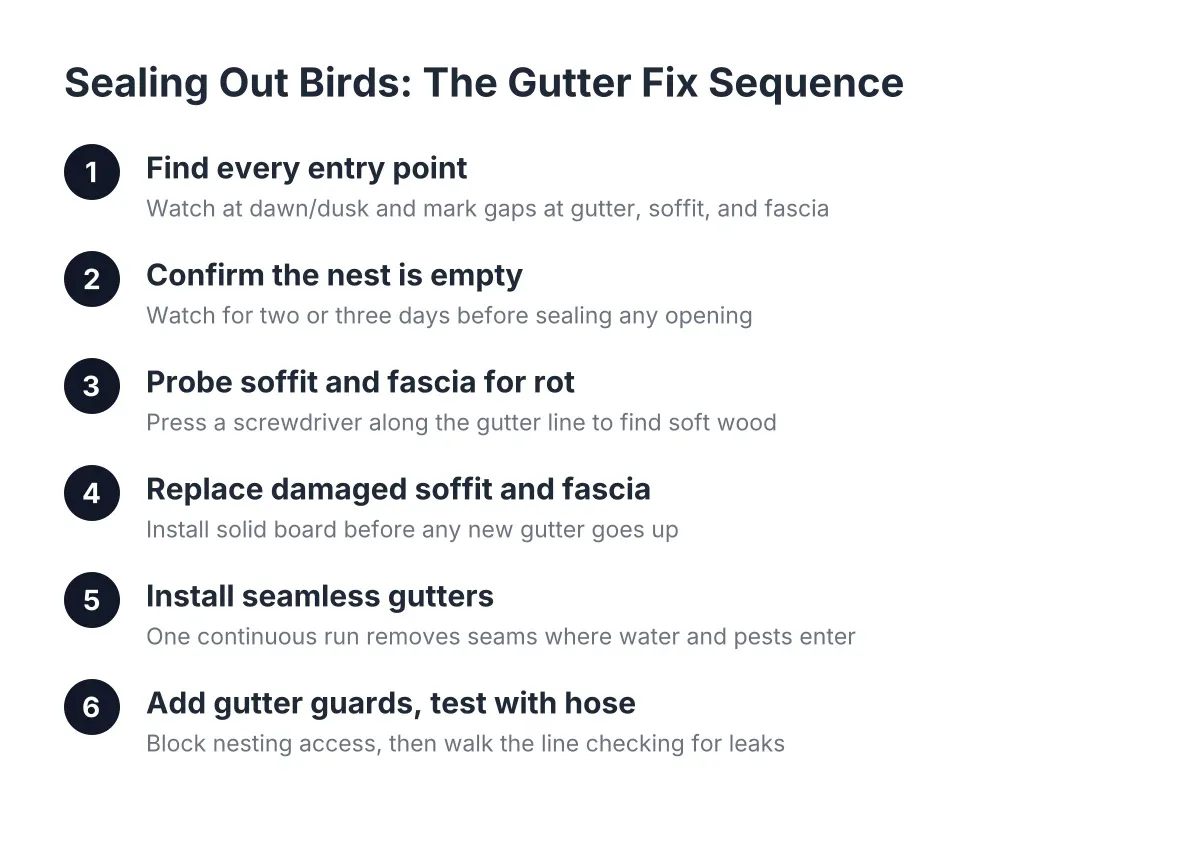
Step 1: Find Every Entry Point Before You Fix Anything
Walk the house in the early morning or at dusk, when birds are most active. Watch where they go in and out. Mark each spot with painter's tape on the wall below so you can find it later from a ladder.
Check these locations, because they account for most entries:
- Gaps between the gutter back edge and the fascia board, where a gutter has pulled loose
- Holes or soft spots in the soffit panels, especially at corners and over porches
- Missing or bent soffit vent screens
- The open ends of gutters where an end cap fell off or was never sealed
- The gap behind a gutter where it was hung over or under the drip edge incorrectly
That last one matters more than most homeowners realize. A common shortcut, especially with plastic gutters hung by a handyman, leaves a gap behind the gutter because the drip edge was never bent to direct water into the trough. Water runs behind the gutter, rots the fascia, and the gap becomes a doorway for wrens and rats.
Step 2: Confirm the Nest Is Empty Before Sealing
Never seal an opening with animals still inside. A trapped bird or squirrel will claw at the ceiling, die in the wall, or chew a new exit. Watch the entry point at dawn and dusk for two or three days. Tap the soffit and listen.
For most songbirds, you may need to wait out the nesting cycle, since many native birds have legal protections while actively nesting. If you hear a large animal, or you suspect bees or wasps, bring in a wildlife or pest professional first. This is the one part of the job where a gutter crew hands off; removal is a pest job, but the permanent fix afterward is a construction job. You do not have to pay two companies to do the same work twice, though. The removal company gets the animal out, and the repair work seals the building so it never happens again.
Step 3: Probe the Soffit and Fascia for Rot
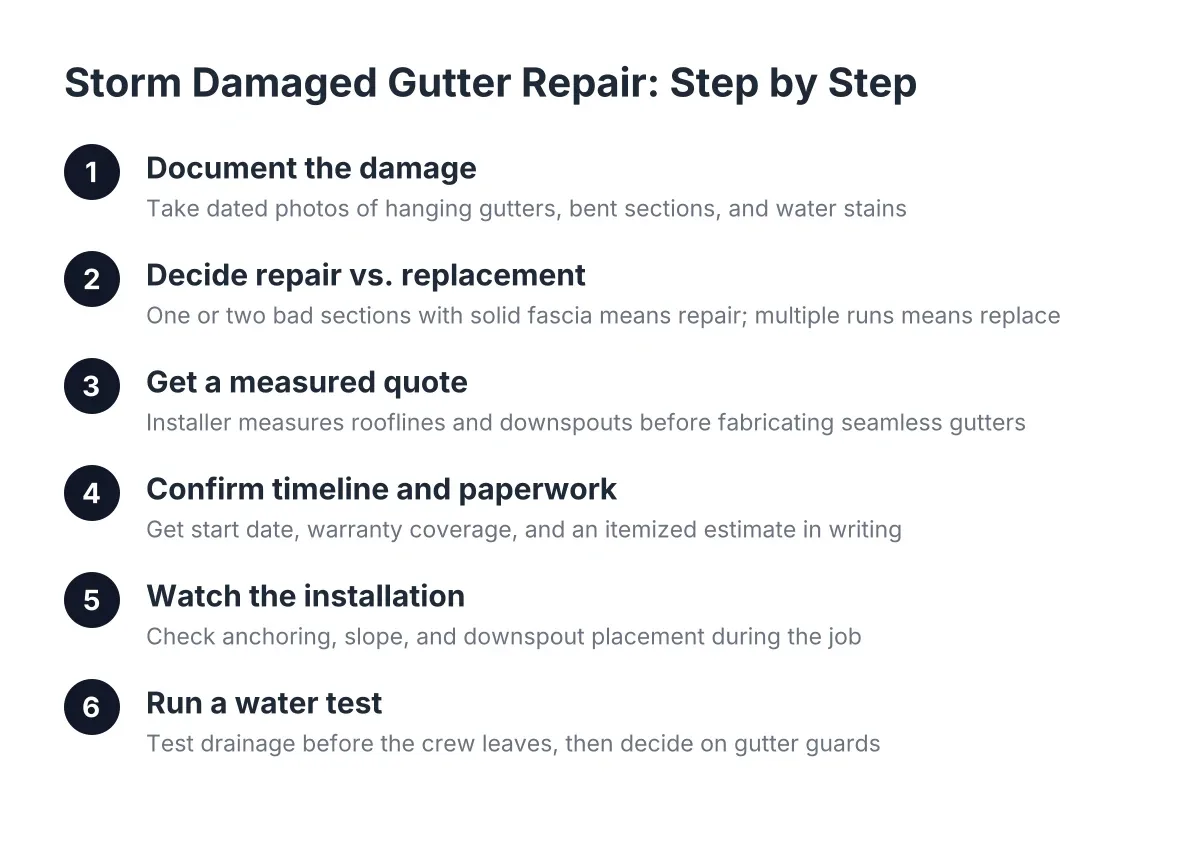
Press a screwdriver into the fascia board along the full gutter line, not just at the hole. If the tip sinks in, the wood is rotten and needs replacement, not a patch. Do the same with the soffit panels around the entry point.
Here is the honest trade-off homeowners worry about: fascia replacement costs more than a mesh patch. But a patch screwed over rotten wood holds for one season at most. The screws pull out of soft wood, the animal pries the edge, and you are back where you started, now with a nest deeper in the ceiling. If the rot runs more than a couple of feet, plan on soffit and fascia replacement for that section before any new gutter goes up. A straight phone conversation about the length of damaged board should give you the cost picture before anyone climbs a ladder.
Step 4: Replace Damaged Soffit and Fascia First
New gutters hang on the fascia, so the board has to be solid before installation. The sequence matters:
- Remove the old gutter section and the rotten fascia board.
- Check the rafter tails behind it; rot sometimes spreads into them.
- Install new fascia board, primed and sealed on all sides.
- Replace damaged soffit panels and reinstall intact vent screens, since soffit vents need airflow but not open holes.
- Seal joints and corners where panels meet, because those seams are where animals pry first.
Skipping this step is the patch-job shortcut that fails. If a contractor offers to hang new gutters over fascia you can dent with a thumbnail, that is a sign they are fixing the look, not the problem.
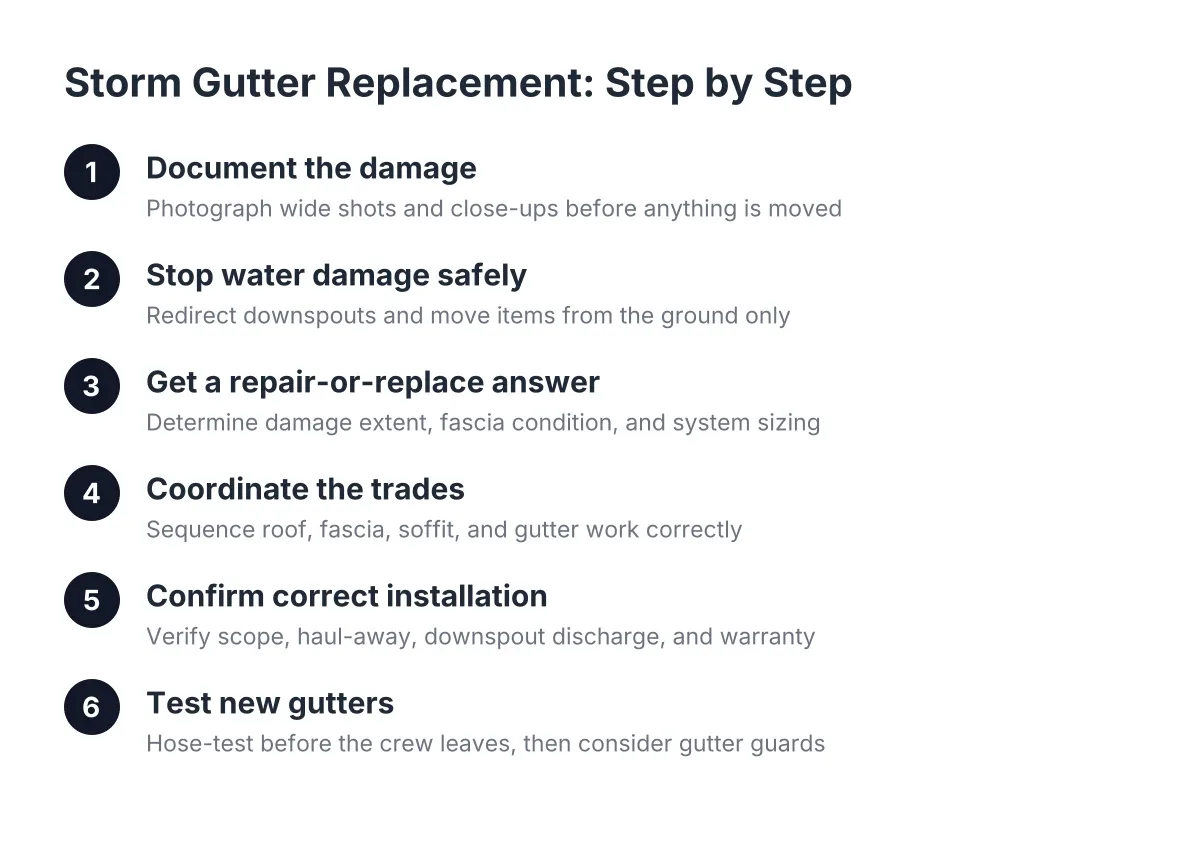
Step 5: Install Seamless Gutters and Prevent Birds from Nesting
Sectional gutters have joints every ten feet, and every joint is a future leak and a future perch. Seamless gutters are formed in one continuous run on site, cut to your exact roof measurements, which removes most of the seams where water escapes and debris catches. Where a seam is unavoidable, such as at a corner, the downstream piece should overlap on top so water flows over the joint toward the downspout, never against it.
Three details separate a tight gutter installation from one that invites animals back:
- The drip edge goes into the gutter. The metal flashing at the roof edge must direct water over the back lip of the gutter, with no gap behind it.
- Hangers go on before the gutter goes up. Installers clip hidden hangers along the run on the ground, which keeps a long section rigid when lifted and anchors it into solid fascia every couple of feet.
- End caps get sealed. An open gutter end is a ready-made birdhouse. Caps should be crimped and sealed, not pressure-fit.
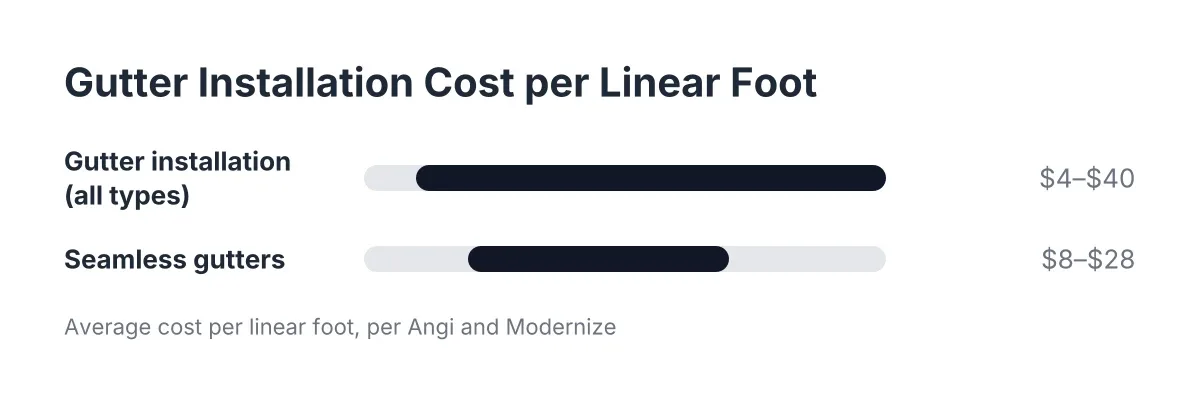
For budgeting context, gutter installation runs about $4 to $40 per linear foot depending on material and gutter type, according to Angi. Seamless gutters specifically average $8 to $28 per linear foot nationally, according to Modernize. Your actual number depends on gutter length, material, roofline complexity, and how much soffit and fascia work the job includes, which is why a measured quote for gutters beats any calculator.
Step 6: Add Gutter Guards to Block Nesting in Gutters
An open gutter full of leaves is nesting material plus shelter in one package. Gutter guards or gutter screens cover the trough so debris and birds stay out while water flows in. A 2025 survey found 70% of homeowners cited preventing clogs or flooding as their main reason for installing gutter guards, according to This Old House, but for a nesting problem the cover itself is the point.
Choose a screen that fastens to the gutter, not one that rests loose under the shingles. Loose mesh is exactly the DIY patch that birds pull aside. In Orlando, the screen also has to pass heavy thunderstorm flow, so fine-mesh guards sized for high water volume beat cheap snap-in plastic. As a bonus, you climb the ladder less; nearly 43% of homeowners with guards save 4 to 8 hours a year on gutter cleaning, according to This Old House.
Step 7: Test With a Hose and Walk the Line
Before the ladder goes back on the truck, run a garden hose into the gutter at the far end from the downspout. Water should move steadily toward the outlet with no pooling, which would signal a slope problem. Check that downspouts discharge well away from the foundation; downspout extensions fix splash-back that rots the next fascia board.
Then do a final animal check. Suppose a homeowner in a 1990s Orlando block home had starlings entering above the garage. In that scenario, the fix was two sections of fascia replacement, a new seamless gutter run, screens across the full length, and a dusk watch for a week afterward to confirm the birds gave up and moved on. That last watch is free, and it is the proof the job worked.
Why One Crew Beats a Patchwork of Fixes
The nesting problem sits at the intersection of water damage and wildlife, which is why homeowners get bounced between pest control and handymen. The construction side, which is the permanent side, is one scope: soffit and fascia repair, seamless gutter installation, and gutter guards, done in that order by one crew that understands how the three pieces fit.
Working at the roofline carries a real fall risk, and bending drip edge or forming seamless runs takes equipment most homeowners do not own. If the damage is more than one small panel, have a professional walk the roofline, explain what drives the price up or down in plain language, and put the full scope in writing before work starts. Once the water path is right and the openings are sealed with solid wood and fastened screens, the scratching in the ceiling stops, and it stays stopped.
If you need gutter installation, Orlando Gutter Installers can help.
Prefer to talk it through? Call (689) 399-8982 — a quick call is usually the fastest way to get a straight answer for your situation.