Gutter Installation in Orlando: A Step-by-Step Guide to Doing It Right
If your gutters overflow every time a summer storm rolls through, the problem is often the gutters themselves, not just the debris in them. Done right, gutter installation in Orlando starts long before anyone picks up a ladder. Understanding the seamless gutter installation steps starts with a diagnosis, careful measurements, and a plan sized for Central Florida rain. This guide walks through the process step by step, so you know what a proper job looks like and what drives the cost before you hire anyone.
Say a homeowner in Orlando has paid for gutter cleaning three times this year, and the gutters still waterfall over the front walk during every hard storm. In that scenario, cleaning is treating a symptom. The real fix is usually a correctly sized seamless gutter system with the downspouts in the right places. Here is how that job should go, start to finish.
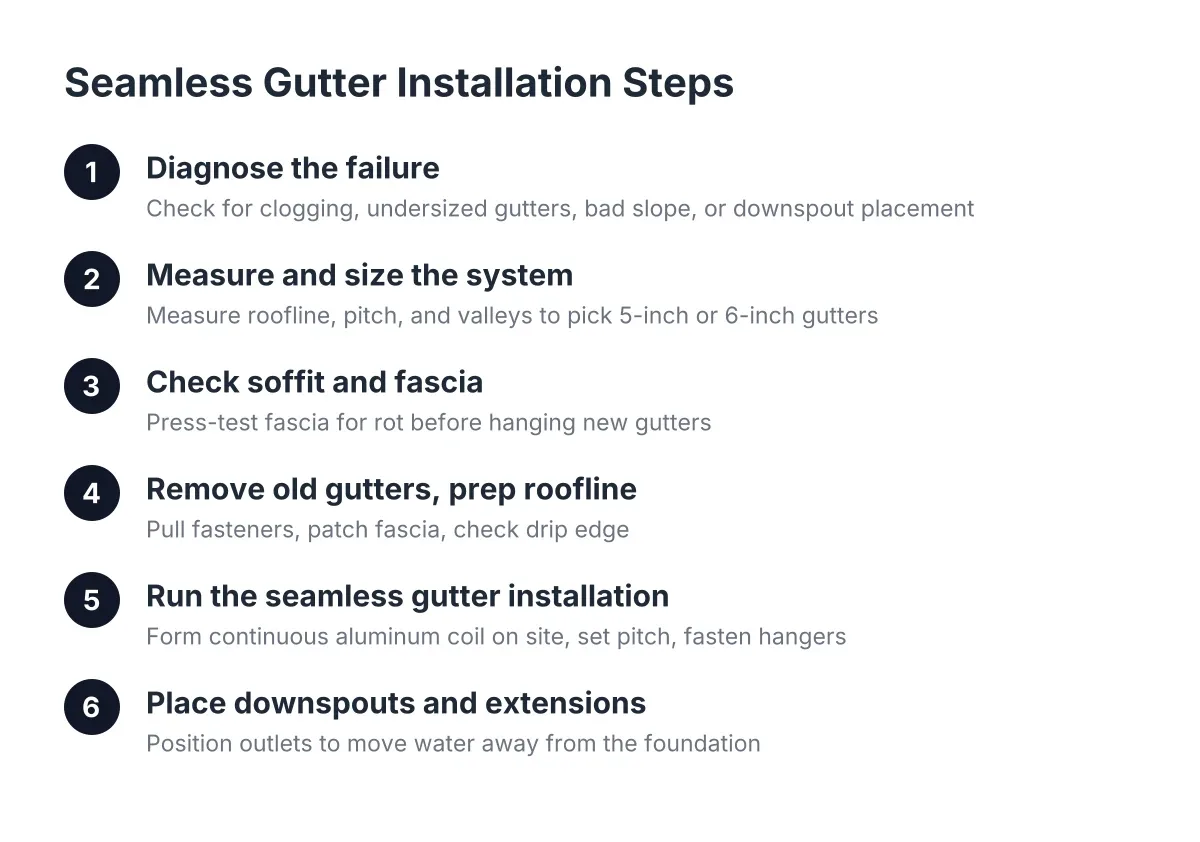
Step 1: Diagnose Why the Old Gutters Keep Failing
Before replacing anything, figure out what is actually wrong. Chronic overflow has four common causes, and each one points to a different fix:
- Clogging. Leaves, shingle grit, and oak debris block the trough or the downspout openings.
- Undersized gutters. A large or steep roof dumps more water than a small gutter can carry during a Central Florida thunderstorm.
- Bad slope. Gutters that have sagged or were hung flat let water pool and spill instead of draining.
- Downspout placement. Too few downspouts, or downspouts in the wrong spots, force one section to handle the whole roof.
A good installer walks the roofline and tells you which of these applies. If the gutters are the right size and just need a slope correction, gutter repair may be the honest answer. If they are too small or past their useful life, replacement is the fix that ends the cycle. Be wary of anyone who quotes new gutters without explaining why the old ones failed; you could end up with new gutters that overflow for the same old reason.
Step 2: Measure the Roof and Size the System
Accurate measurements come before any fabrication or cutting. The installer should measure every run of roofline, note the roof pitch, and map where the valleys concentrate water. Those numbers determine the gutter size, usually 5-inch or 6-inch for homes, and how many downspouts the system needs.
This step matters most for the chronic-overflow home. If your roof sheds more water than a 5-inch gutter can handle in a heavy downpour, a 6-inch seamless gutter with larger downspouts is the permanent fix. Skipping the math here is how homeowners end up paying twice.
Step 3: Check the Soffit and Fascia First
Gutters hang from the fascia board, so the fascia has to be solid. Years of overflow soak the fascia and soffit, and rotted wood will not hold gutter hangers through a storm season. An installer should press-test the fascia along the full run and flag any soft spots.
If there is rot, soffit and fascia repair or replacement happens before the new gutters go up. This adds cost, but hanging new gutters on rotted wood wastes the whole job. Storm-damaged homes often fall into this category; a hurricane that pulls a gutter loose usually tears up the fascia behind it too. One caveat: if your roof itself needs replacement, do that first. Roofers often damage or remove gutters during tear-off, and combining the timing avoids paying to install gutters twice.
Step 4: Remove the Old Gutters and Prep the Roofline
Next, the crew takes down the old gutters and downspouts and hauls away the debris. They pull old fasteners, patch holes in the fascia, and check the drip edge. The drip edge is the metal flashing at the roof's bottom edge, and it has to direct water into the new gutter.
This is a spot where sloppy work shows up later. Gutters hung without the drip edge tucked correctly leave a gap behind the gutter, so water runs down the fascia instead of into the trough. That slow leak rots the fascia and soffit over a few rainy seasons, and the homeowner never sees it happening.
Step 5: Run the Seamless Gutter Installation
Here is where seamless gutters earn their name. The installer rolls continuous aluminum coil through a forming machine on site, producing one unbroken gutter cut to the exact length of each roofline run. No seams along the run means no joints to leak or snag debris, which is exactly what a chronic-overflow home needs. The core steps in seamless gutter installation involve securing the framework, setting the proper pitch, and fastening everything down before moving to downspout placement.
A typical crew pre-attaches the hidden hangers along the gutter before lifting it. The brackets clip over the back edge and hook under the front, which stiffens the long section so it does not flex and crease on the way up. Hangers that hook into the gutter go in before the end caps close things off, since access gets harder after that.
Setting the gutter follows a clear sequence:
- Secure the middle of the run first.
- Set the high end, then the low end near the downspout.
- Check the pitch along the full length, then fasten everything down.
- Where two sections must meet, lap the downstream piece on top so water flows over the seam, not against it.
The slope is subtle, a gradual fall toward the downspout that the eye barely catches from the ground. Too flat and water pools; too steep and the gutter looks crooked and can overshoot the downspout in heavy flow.
Step 6: Place Downspouts and Extensions Where the Water Should Go
Downspouts decide where all that roof water lands. Each one should sit where it can carry its share of the roof without overloading, and the outlets should move water away from the foundation, not dump it beside the slab. If you have noticed water pooling near your foundation after storms, this step is where that problem gets solved.
Downspout extensions carry the discharge several feet out, toward a swale, a drainage path, or daylight away from the house. On Orlando lots with flat grading, skipping extensions sends every storm's runoff straight back against the footer. Extensions are inexpensive relative to the rest of the job and do a lot of the protective work.
Step 7: Test the System With a Hose Before Signing Off
A finished installation gets tested, not just eyeballed. The installer runs a hose into the gutter at the high end and watches the water travel. It should move steadily toward the downspout and drain completely, with no standing water left in the trough. Pooling spots mean the slope needs adjustment before the crew leaves.
Ask to watch this test. It takes a few minutes and proves the system works before the first real storm does the testing for you. Reputable gutter installation work also comes with a warranty covering labor and materials, so get the terms in writing.
Step 8: Decide Whether Gutter Guards Belong on Top
Gutter guards and gutter screens are the last decision, and they are worth weighing honestly. According to This Old House, 70% of homeowners who install gutter guards do it mainly to prevent clogs or flooding, and nearly 43% save 4 to 8 hours a year on cleaning. For a home under oaks or pines, screens installed over new seamless gutters can end the cleaning treadmill.
However, guards are not magic. They reduce cleaning, they do not eliminate it, and fine debris like pine needles still needs occasional attention. If your overflow problem was undersized gutters rather than clogs, guards alone would not have fixed anything. The honest sequence is size first, screens second.
What Drives the Cost of Seamless Gutter Installation
Gutter installation cost comes down to a handful of factors, not a mystery number. As of 2026, Angi puts the national range at $4 to $40 per linear foot depending on material and gutter type, and Modernize puts seamless gutters at $8 to $28 per linear foot on average. Your specific price lands inside those ranges based on:
- Total linear footage. More roofline means more material and labor.
- Gutter size and material. 6-inch gutters cost more than 5-inch; copper costs more than aluminum.
- Roofline complexity. Multiple stories, steep pitches, and lots of corners add labor.
- Soffit and fascia condition. Rot repair before installation adds to the total.
- Downspouts and extensions. More downspouts and longer drainage runs add material.
- Gutter guards. Screens are an added line item on top of the gutters themselves.
A straightforward one-story home with sound fascia sits at the low end. A two-story house with storm-damaged fascia, a complex roofline, and guards on every run sits higher. Any quote for gutters should break these factors out so you can see what you are paying for.
When to Bring In a Professional
Gutter work happens on ladders at roof height, and a fall is the kind of mistake you do not get to redo. Fabricating true seamless gutters also requires a forming machine that homeowners do not own. For a simple single-story section repair, a careful DIYer can manage; for full replacement, fascia work, or anything on a second story, hire a professional and let the warranty cover the outcome.
If your gutters have overflowed through three cleanings this year, stop paying for the symptom. Get a diagnosis, get the system sized for Central Florida rain, and get the job done once.
If you need gutter installation in Orlando, FL, Orlando Gutter Installers can help.
Prefer to talk it through? Call (689) 399-8982 — a quick call is usually the fastest way to get a straight answer for your situation.