8 Questions to Ask a Gutter Installer Before You Sign Anything in Orlando
An inspector flags sagging gutters and rotted fascia. A buyer's agent starts using it to chip away at your price. Suddenly you need a gutter contractor fast, and you have no idea who to trust. When you're interviewing a gutter installer, the right gutter installer questions to ask will save you money, protect your closing date, and keep you from paying for work you do not need. Here are the eight that matter most, whether you are fixing a house to sell or repairing storm damage on the home you live in.
Each question below comes with the answer you should expect to hear. If a contractor dodges, rushes, or answers with a sales pitch, that tells you plenty.
1. What exactly is driving the price on my house?
The honest answer names the cost factors on your specific home, not a vague "it depends." Gutter length, material, roofline complexity, and the condition of your soffit and fascia drive the price up or down. A one-story ranch with four straight runs costs less than a two-story house with multiple gables and valleys.
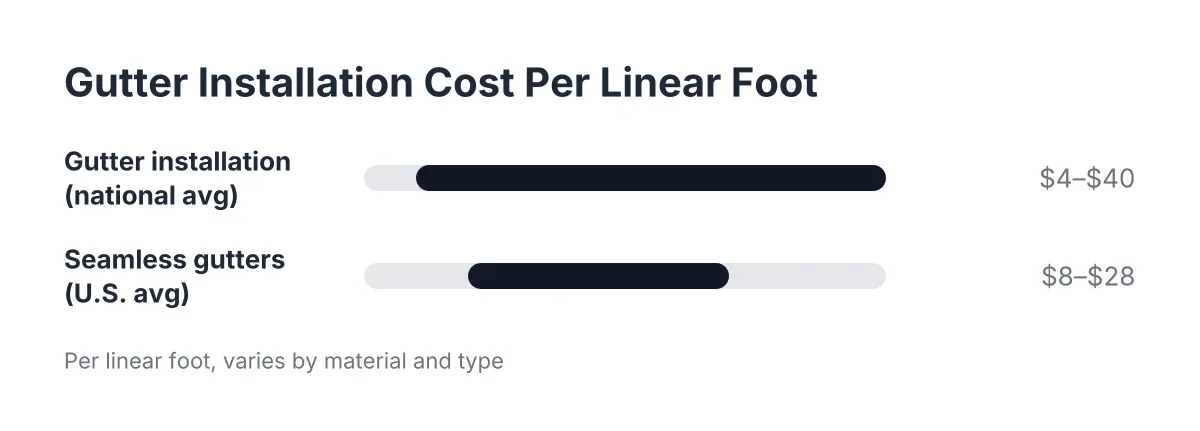
Nationally, gutter installation costs average $4 to $40 per linear foot depending on material and gutter type, according to Angi. Seamless gutters typically run $8 to $28 per linear foot on average in the U.S., according to Modernize. Those are wide ranges for a reason; the factors above decide where your house lands.
A good installer walks the property, measures, and explains the math before anyone sets foot on the roof. If someone quotes a number over the phone without seeing the roofline, be careful. If someone quotes a number far below everyone else, be even more careful.
2. Do I actually need full replacement, or will a repair pass?
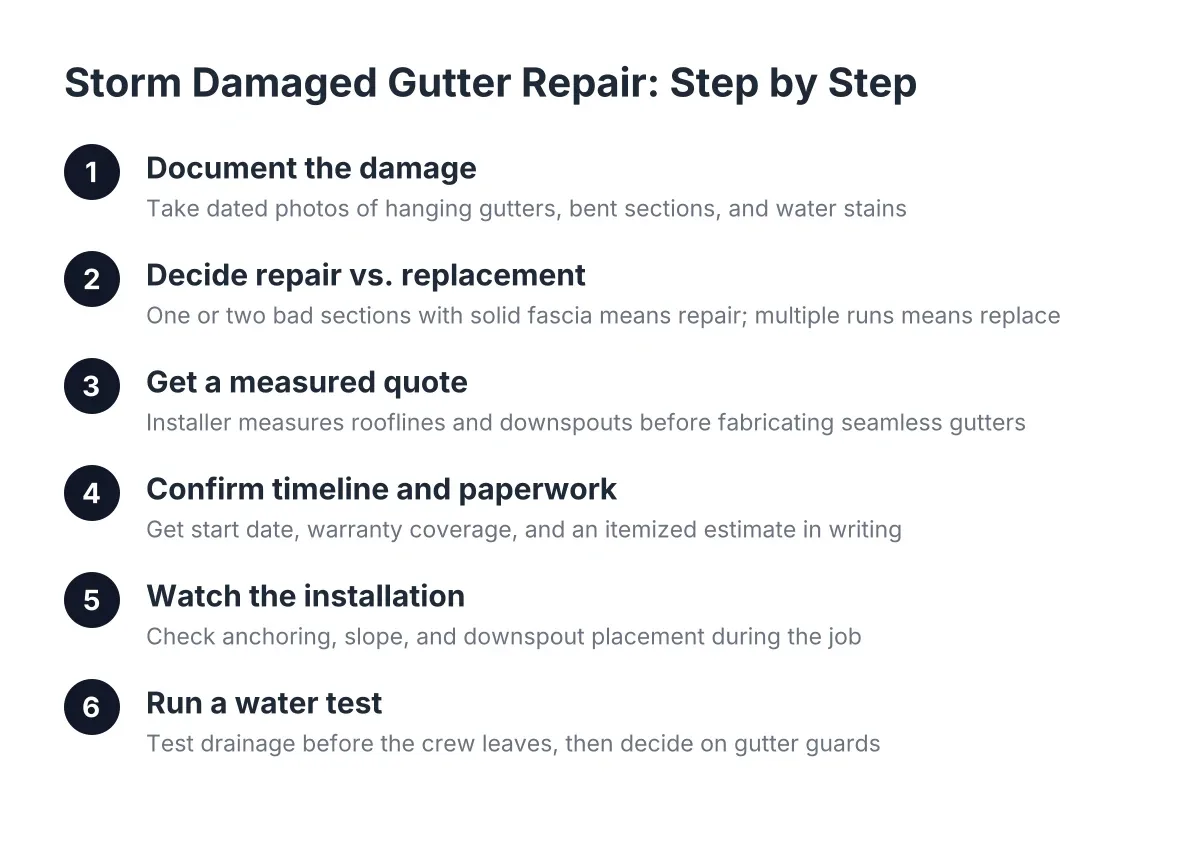
A straight answer here separates honest contractors from upsellers. Sometimes a sagging run needs new hangers and a slope correction, not new gutters. Sometimes the fascia behind the gutter is rotted and a patch would just hide the problem until the inspection re-walk finds it.
This matters most if you are selling. Suppose an inspection report flags one sagging 30-foot run and a soft spot in the fascia near a corner. In that scenario, a repair plus a short section of fascia replacement might satisfy the inspector, while a whole-house replacement would be money you never get back at closing. Ask the installer to separate must-fix items from nice-to-have upgrades, and to put both in writing so you can decide.
The flip side is also true. If the gutters are undersized for Central Florida's summer thunderstorms, or the fascia rot runs the length of a wall, a cheap patch can fail before the sale closes. An honest contractor tells you which situation you are in and why.
3. Will you give me a written, itemized quote for gutters?
Yes should be the only answer. A written quote for gutters should list linear footage, material, number of downspouts, gutter guards if included, and any soffit and fascia work as separate line items. Itemized pricing lets you cut what you do not need instead of accepting or rejecting one lump sum.
For sellers, that paper matters twice. First, it lets you show the buyer's agent a credible repair cost instead of letting them invent an inflated one. Second, the final invoice goes straight into your closing package as proof the flagged defects were corrected.
Searching for cheap gutter installation near me will surface plenty of low lump-sum bids. An itemized quote is how you find out whether cheap means efficient or means corners cut on hangers, slope, and fascia prep.
4. What hangers and fastening will you use, and how far apart?
Hanger type and spacing decide whether your gutters survive the next heavy storm season. Hidden hangers screwed into solid fascia hold far better than spike-and-ferrule nails that work loose over time. Hanger quality varies widely between installers, and it is invisible once the job is done, which is exactly why you ask before signing.
This question matters doubly in Orlando. Summer thunderstorms dump heavy rain fast, and a gutter full of rushing water puts real load on every fastener. Ask what gauge of hanger they use and how close together they set them. A pro answers in specifics without hesitation.
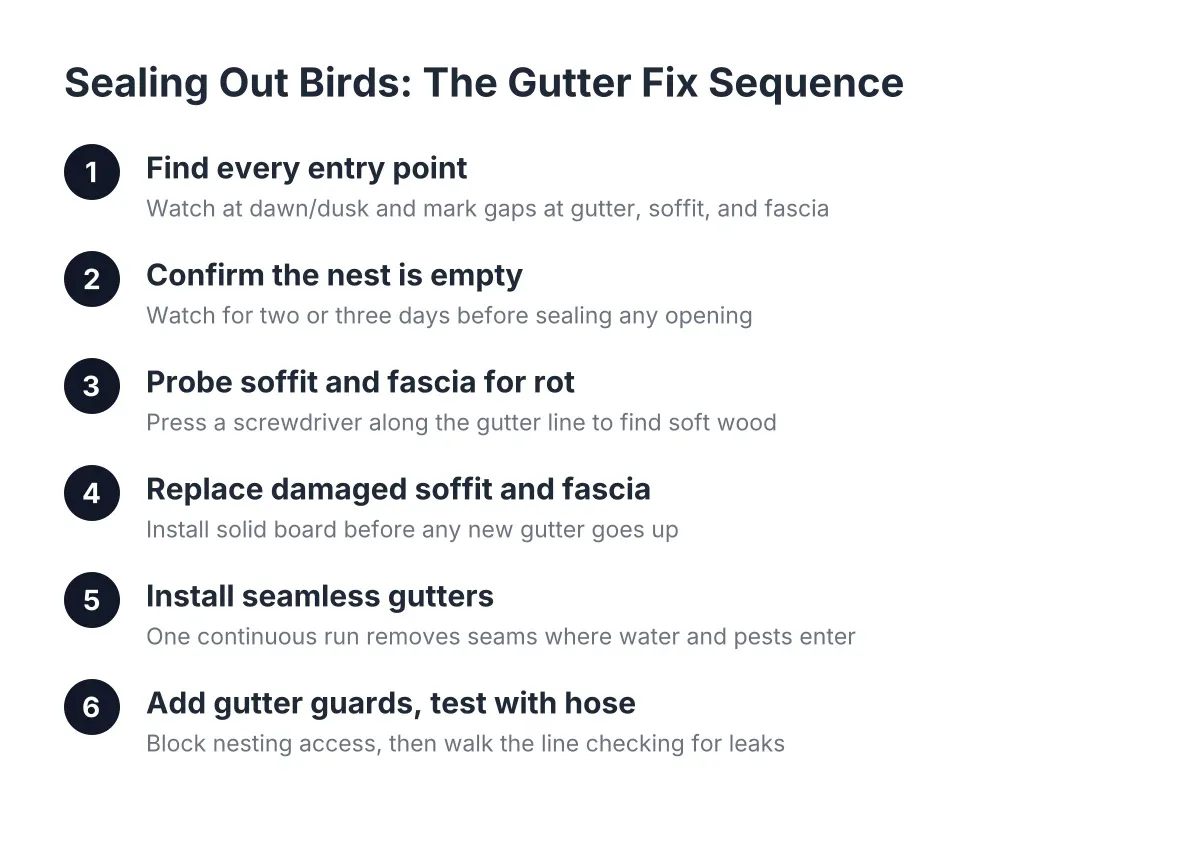
In addition, ask what happens if they find rotted fascia behind the old gutter. New hangers screwed into soft wood will not hold, so the right answer involves replacing the bad fascia section first, with the added cost explained before the work continues.
5. How do you set and test the slope?
Listen for a process, not a shrug. Gutters need a consistent pitch toward the downspouts, and careful installers set the middle first, then the high and low ends, then check the pitch before final fastening. After hanging, a water test with a hose shows whether the run drains clean or pools in spots that need adjustment.
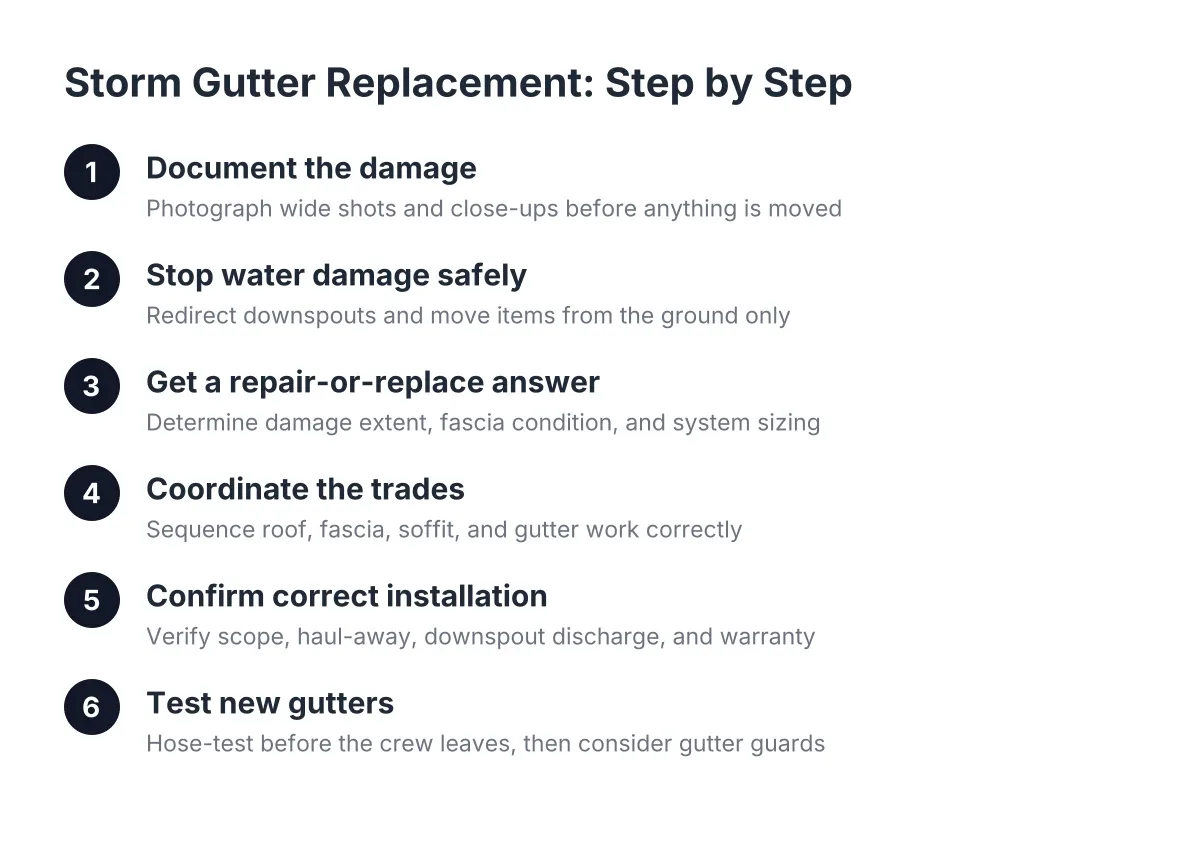
A full water-soak test also reveals leaks at end caps, corners, and outlets, which tells the installer where extra flashing or sealant is needed. If a contractor has never heard of testing with water, the first real test will be a July downpour over your fascia.
Pooling water is the quiet killer here. It breeds mosquitoes, adds weight that pulls hangers loose, and overflows against the fascia you just paid to fix. Two minutes with a hose prevents all of it.
6. Where will the water go once it leaves the downspouts?
The answer should mention your yard, your foundation, and your neighbors, not just the gutters. Downspouts that dump water at the base of the wall move the problem from your roofline to your slab. Downspout extensions carry water away from the foundation, which matters on Central Florida's flat lots where runoff has nowhere obvious to go.
Ask the installer to walk the discharge points with you. A thoughtful contractor will flag spots where water would pool against the house, a walkway, or an AC pad, and suggest extensions or rerouting. For storm-damaged homes, bundling drainage fixes with the gutter work is usually cheaper than calling someone back later.
Here is a quick checklist for that walk-around:
- Does each downspout discharge at least several feet from the foundation?
- Does any discharge point aim at a sidewalk, driveway, or the neighbor's yard?
- Are there low spots where water already collects after a storm?
- Would a simple extension or splash block solve it, or does the grading need attention?
7. What warranty covers the labor and the materials?
Reputable gutter work comes with a warranty covering both labor and materials for problems that show up after installation, and you want the terms in writing. Material warranties come from the manufacturer; labor warranties come from the installer. Ask for both, and ask what the labor warranty actually covers: a seam that opens, a hanger that pulls loose, a leak at a corner.
However, read the fine print on exclusions. Some warranties exclude damage from clogs, which is one reason many homeowners add gutter guards or gutter screens at install time. A 2025 survey by This Old House found 70% of homeowners cited preventing clogs or flooding as their main reason for installing gutter guards.
If you are selling the house, a transferable warranty is a quiet selling point. It gives the buyer one less thing to negotiate over and gives their inspector less to question.
8. Can you hit my timeline, and what could delay the job?
A trustworthy answer includes both a schedule and the things that could break it. Weather is the honest one in Orlando; nobody hangs gutters safely in a lightning storm, and summer afternoons bring them on schedule. Hidden fascia rot is the other common delay, since bad wood must be replaced before new gutters go up.
Therefore, if you have a closing date, say so up front and ask the installer to sequence the work around it. Also ask whether a roof replacement is in the picture. If a roofer is about to tear off the roof, gutters should wait; doing both at once avoids paying to remove and reinstall gutters twice.
One honest limitation: no contractor can promise a fixed completion date during peak storm season, and anyone who does is guessing. What they can do is tell you their current backlog, their rain plan, and what happens to your slot if a hurricane rolls through.
More gutter installer questions to ask if you are adding guards
If gutter guards or gutter screens are part of the job, add a few questions to the list. Ask which guard type they recommend for your trees, since mesh, foam, and micro-mesh each handle oak leaves and pine needles differently. Ask whether the guards void or change the gutter warranty. Additionally, ask what maintenance the guards themselves need, because "never clean again" is a sales line, not a fact.
The payoff can be real. This Old House's 2025 gutters survey found nearly 43% of homeowners with guards save 4 to 8 hours per year on cleaning, while 44% of homeowners nationwide never clean their gutters at all. Guards will not fix that second group's problem, but they shrink the chore for everyone else.
For a pre-sale fix, basic screens often make more sense than premium micro-mesh. You want the gutters clean and functional for inspection, not upgraded for a decade you will not own the house.
The pattern behind all eight questions
Every question on this list tests the same thing: will this installer explain the job in plain language before asking for your signature? Price factors, repair versus replacement, hangers, slope, drainage, warranty, and timeline are all knowable before work starts. A contractor who answers them clearly will probably handle the surprises clearly too.
Keep the list on your phone when you call around. The best gutter installer questions are not about catching anyone in a lie; they are about finding the one who answers like a neighbor explaining the job over the fence. In a 2026 market where buyers' inspectors scrutinize every roofline and summer storms test every seam, that is the installer worth hiring.
If you need gutter installation, Orlando Gutter Installers can help.
Prefer to talk it through? Call (689) 399-8982 — a quick call is usually the fastest way to get a straight answer for your situation.