How to Size Gutters for Central Florida’s Heavy Summer Storms: A Step Guide
Learning how to size gutters for Central Florida's summer storms is the difference between a system that works and one that overflows every July afternoon. A gutter that handles rain fine in a milder climate can dump water right over the edge here. That water ends up against your fascia, your foundation, and your landscaping. If you are getting a house ready to list, or you build homes and need a spec that holds up, sizing is the one decision you cannot patch later.
This guide walks through the sizing process step by step, the same way a seamless gutter crew would think it through on site. No invented price figures, just the factors that decide what size you need and what drives the cost of gutters in Florida up or down.
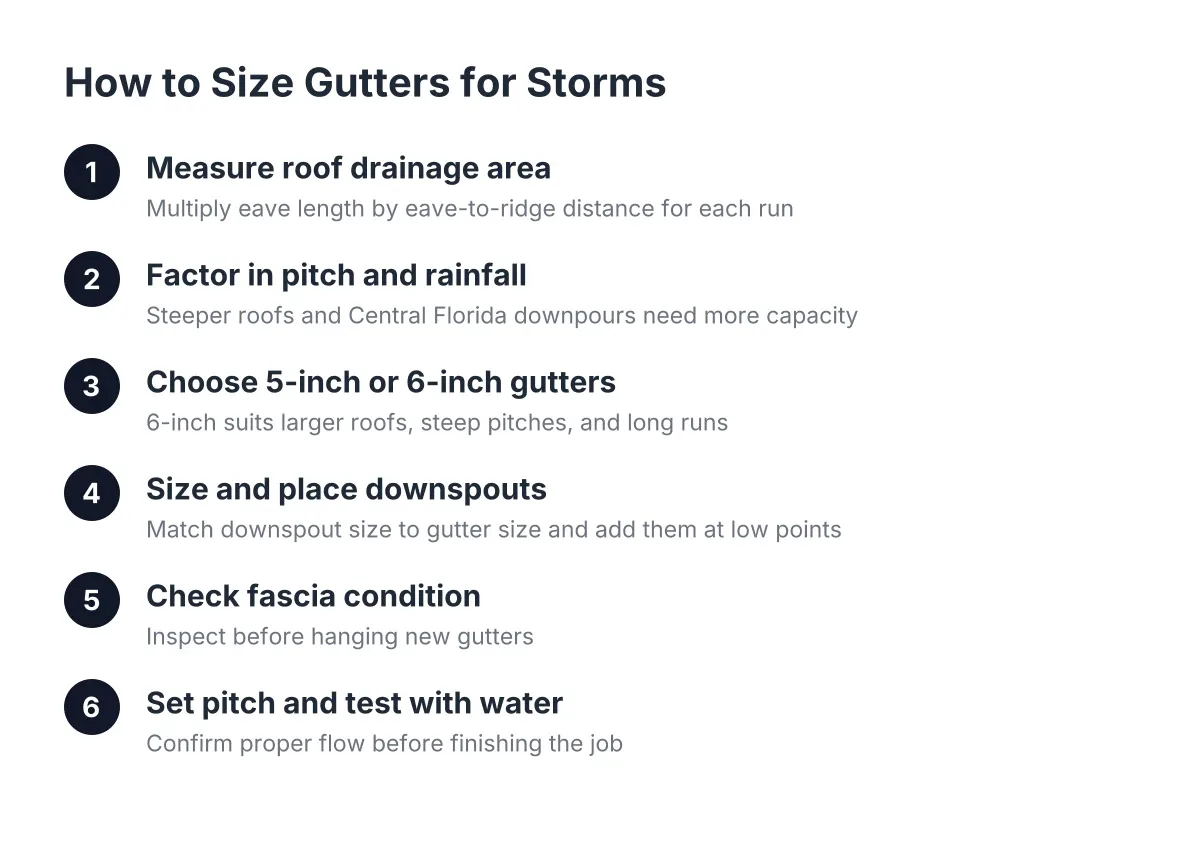
Step 1: Measure Your Roof's Drainage Area
Start with the roof, not the gutter. Gutter size is driven by how much water the roof sheds into each run, and that depends on the square footage draining to that section.
Walk the house and sketch the roofline. Break it into sections, one for each gutter run. For each section, measure the length along the eave and the horizontal distance from eave to ridge. Multiply the two numbers. That gives you the drainage area for that run.
Accurate measurements matter more than most homeowners expect. Seamless gutters are fabricated on site to the exact length of each run, so the crew measures before cutting anything. If you are a flipper comparing bids, a contractor who measures the roof before quoting is giving you a real number, not a guess.
In addition, note where two roof planes funnel into one valley. A valley can dump the water from two large sections into a few feet of gutter. That spot often needs a larger gutter or an extra downspout even when the rest of the house does not.
Step 2: Factor In Roof Pitch and Central Florida Rainfall
A steep roof sheds water faster than a shallow one. Water moving fast off a steep pitch can overshoot a small gutter entirely, especially during the hard, sudden downpours Central Florida gets through the summer thunderstorm season.
Therefore, after you calculate drainage area, adjust for pitch. The steeper the roof, the more capacity you should plan for. Installers do this with a pitch multiplier; the practical takeaway for a homeowner is simple. A steep roof plus a big drainage area pushes you toward the larger gutter size, every time.
Central Florida's rain pattern matters as much as the total amount. Our storms drop a lot of water in a short burst, which is exactly the condition that overwhelms an undersized gutter. A gutter sized for a slow, steady drizzle will overflow in an Orlando August even if the yearly totals look manageable on paper.
Proper Gutter Sizing for Storms in Central Florida
Sizing gutters for Central Florida means planning for short, intense summer downpours rather than average rainfall. The region's afternoon thunderstorms can overload a gutter in minutes, so installers size for peak flow, not typical flow. That is why many homes here end up with 6-inch gutters where a 5-inch system would pass in a drier state.
Sheet flow is the tell. If you have watched rain pour over the front edge of an existing gutter during a storm, the gutter is either undersized, clogged, or pitched wrong. Sizing correctly solves the first problem; the next steps handle the others.
Step 3: Choose Between 5-Inch and 6-Inch Seamless Gutters
Most homes use one of two sizes of seamless K-style gutter: 5 inch or 6 inch. The 6-inch profile carries considerably more water and pairs with a larger downspout, which also clogs less often.
Here is how the choice usually breaks down:
- 5-inch gutters suit smaller homes with simple rooflines, moderate pitch, and short runs. They cost less in material and are the common builder-grade choice.
- 6-inch gutters suit larger roofs, steep pitches, long runs, and valleys that concentrate flow. They are the safer call for most Central Florida two-story homes.
- Oversized or box gutters are for unusual cases, like metal roofs with long uninterrupted planes or commercial-style rooflines. Most houses never need them.
For a pre-listing flip, the 5-inch versus 6-inch question is mostly about not creating a new problem. Suppose an inspector flagged sagging, overflowing gutters on a 2,400-square-foot two-story with a steep roof. In that scenario, replacing them with the same undersized 5-inch system might look fine on the re-walk but overflow during the buyer's first summer. A 6-inch system on the heavy-flow sections costs more in material, not a different job entirely, and it closes the issue for good.
Builders face the same trade-off at spec time. Standardizing on 6-inch seamless gutters across a subdivision adds a modest material cost per home and cuts callbacks about overflow and staining on the fascia. For context on material pricing, gutter installation runs about $4 to $40 per linear foot depending on material and gutter type, according to Angi, with seamless systems typically landing between $8 and $28 per linear foot, according to Modernize. Length, material, and roofline complexity move you within those ranges.
Step 4: Size and Place the Downspouts
A big gutter with too few downspouts still overflows. The downspout is the drain; the gutter is only the collection trough. Sizing them together is what makes the system work in a storm.
Match downspout size to gutter size. A 6-inch gutter should get the larger downspout, not the small one left over from the old system. Then look at placement:
- Put a downspout near every low point and every valley discharge.
- Keep runs short; long runs feeding a single downspout are the most common overflow point on Central Florida homes.
- Add downspout extensions so water discharges away from the slab, not into the flower bed against the foundation.
However, do not let a contractor skip the drainage conversation. Where the water goes after it leaves the downspout matters as much as the gutter size. On flat Orlando lots, water that drops at the foundation can pond against the house, and downspout extensions are a cheap fix compared to the damage.
Step 5: Check Fascia Condition Before You Hang Anything
Gutters fasten to the fascia board. Rotted or soft fascia will not hold hangers, no matter what size gutter you choose. This step trips up more pre-listing sellers than any other.
For example, say a flipper gets an inspection report listing sagging gutters and rotted fascia at two corners. Replacing only the gutters would mean screwing new hangers into bad wood, and the sag would return before closing. The right sequence is fascia replacement first, then the new gutters, documented on one invoice for the closing package. Soffit and fascia work done at the same time as gutter installation is cheaper than two separate trips, because the crew is already set up at the roofline.
Hanger quality matters here too. Ask any installer what type and gauge of hanger they plan to use, and how far apart they will space them. Hidden hangers screwed into solid fascia hold Central Florida's heavy, water-loaded gutters; cheap spike-and-ferrule fasteners work loose over time. This is a fair question for any bid, and the answer tells you a lot about the crew.
Step 6: Set the Pitch and Test With Water
Correct sizing only works if the gutter drains. Installers hang gutters with a slight downward slope toward each downspout, set the middle first, then the high and low ends, and check the pitch before final fastening.
After the hang, a careful crew runs a hose through the system and watches it drain. Pooling spots mean the slope needs adjustment. If you are evaluating seamless gutter contractors, ask whether they water-test. It takes minutes and catches problems that otherwise show up during the first real storm, after the crew is gone.
As a result of a proper test, a flipper gets a system that performs cleanly during the inspection re-walk, and a builder gets fewer warranty calls in year one.
Step 7: Decide Whether Gutter Guards Fit Your Situation
Guards do not change gutter size, but clogs shrink effective capacity, so they belong in the sizing conversation. A 6-inch gutter packed with oak leaves carries less water than a clean 5-inch one. According to a This Old House survey, 70% of homeowners who install gutter guards cite preventing clogs or flooding as their main reason, and their 2025 survey found 44% of homeowners never clean their gutters at all.
Two rules apply. First, clean the gutters of leaves, sticks, and shingle granules before any gutter screens go on, so the system starts at full capacity. Second, be cautious with large helmet-style covers that extend past the gutter edge. They handle light rain fine, but heavy rain on a steep roof can shoot right over them, which is a poor match for Central Florida storms. Mesh gutter screens that sit flat generally handle hard rain better here.
For a pre-listing seller, guards are usually a nice-to-have, not an inspection fix. Skip them if the budget is tight and the trees are far from the roof. For a long-term owner under oaks, they pay for themselves in skipped cleanings.
When to Bring In a Pro on Gutter Sizing for Storms
The measuring and the 5-versus-6 decision are things a homeowner can reason through. The judgment calls, like valley flow, pitch multipliers, hidden fascia rot, and local drainage, are where an experienced installer earns the money. If your roof has multiple valleys, a metal surface, or a history of overflow, have seamless gutter contractors look at it before you buy anything. A measured, written quote for gutters that explains the size recommendation is worth more than the lowest number from someone searching-friendly but vague.
The honest trade-off: sizing up costs more per foot, and on a small, simple ranch it can be money you did not need to spend. But when you size gutters for Central Florida's storm pattern instead of a national average, you buy a system that stays inside its capacity on the worst afternoon of the summer. For a seller, that means a clean re-inspection. For a builder, that means a spec that does not generate callbacks. Either way, the water goes where it should, which is the whole job.
If you need gutter installation, Orlando Gutter Installers can help.
Prefer to talk it through? Call (689) 399-8982 — a quick call is usually the fastest way to get a straight answer for your situation.