Gutter Installation Warranty: What’s Covered and What Protections to Expect
When a storm rips the gutters off your Orlando home, the last thing on your mind is paperwork. You want the water off your siding and someone out fast. But before you sign with any installer, it pays to understand the gutter installation warranty, what's covered, what's not, and how to spot a warranty that will not be worth the paper it is printed on. Understanding gutter workmanship warranty coverage helps you know what to expect from your installation. The right warranty protects you long after the crew drives away. The wrong one leaves you paying twice for the same job.
This guide walks through the two kinds of warranties every gutter job should carry, what each one actually covers, the fine print that trips homeowners up, and how warranty terms interact with storm damage and insurance claims in Central Florida.
Why Warranty Terms Matter More After a Storm
Storm-damage repairs happen under pressure. Suppose a summer thunderstorm pulls a 40-foot gutter run and a section of fascia off the back of your house. Rain is in the forecast again in two days. You call four companies, two answer, and one can come this week. In that moment, almost nobody asks about warranty terms.
That is exactly when warranty terms matter most. Rushed jobs are where shortcuts happen: hangers spaced too far apart, seams caulked instead of properly sealed, new gutters screwed into rotted fascia that should have been replaced first. A solid warranty means the installer stands behind the work when a problem shows up next storm season. A weak one means every callback is a new invoice.
In addition, Orlando's weather tests gutter work harder than most places. Intense summer thunderstorms dump heavy rain in short bursts, and that volume finds every loose hanger and bad seam. A warranty that would never get used in a dry climate gets tested here every June through September.
Gutter Installation Warranty: What's Covered by Material and Workmanship Warranty Coverage
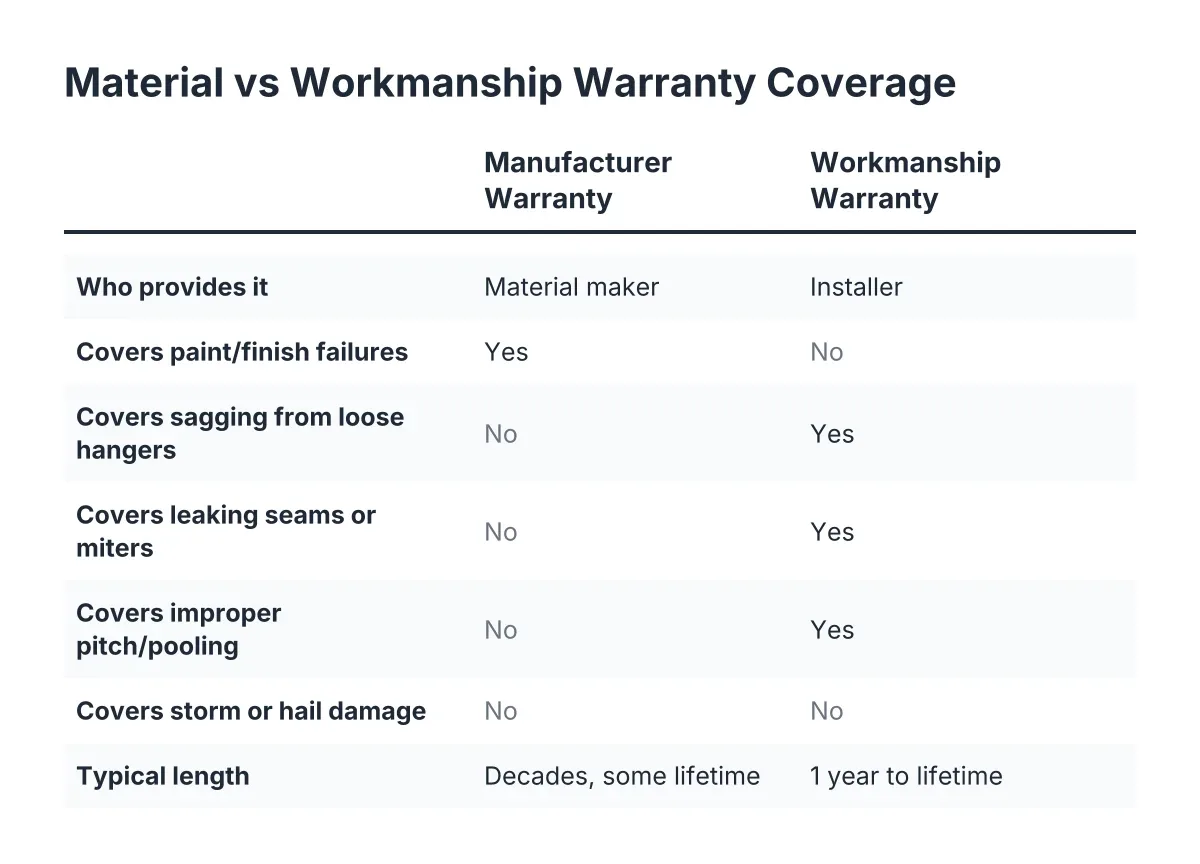
A gutter installation warranty typically comes in two parts: a manufacturer warranty on the materials, and a workmanship warranty on the labor. They cover different failures, come from different parties, and have different lifespans. Most disputes between homeowners and installers come down to confusion about which warranty applies to which problem.
The Manufacturer Warranty on Materials
The material warranty comes from whoever made the gutter coil, downspouts, or gutter guards, not from the installer. It covers defects in the product itself. For aluminum seamless gutters, that usually means the paint finish: cracking, peeling, chalking, or fading beyond a stated level. Some finishes carry coverage that runs for decades, and a few are marketed as lifetime.
Here is what a material warranty generally covers:
- Paint or coating finish failures, like peeling, blistering, or severe fading
- Manufacturing defects in the metal or guard material
- Premature corrosion when the product was used as directed
And here is what it generally does not cover:
- Damage from storms, falling branches, or hail
- Problems caused by poor installation, such as sagging or pulled hangers
- Dents, scratches, or damage from ladders leaning on the gutter
- Clogs, overflow, or drainage problems
Notice the pattern. The manufacturer covers the product, nothing else. If your seamless gutters sag because the hangers were spaced too wide, the manufacturer owes you nothing. That failure belongs to the second warranty.
The Workmanship Warranty on Labor
The workmanship warranty comes from the installer and covers how the gutters were put on your house. This is the warranty that matters most for day-to-day problems, because installation errors cause far more gutter failures than defective materials do. Quality gutter workmanship warranty coverage protects you against the installation errors most likely to show up over time.
A workmanship warranty should cover failures like these:
- Leaking seams, end caps, or miters that were not sealed correctly
- Gutters pulling away from the fascia because of loose or missing hangers
- Improper pitch, so water pools in the run instead of flowing to the downspout
- Downspouts that detach or were routed wrong
Workmanship coverage varies widely. Some installers offer one year, others several, and a few stand behind labor for as long as you own the home. Longer is better, but only if the company plans to be around to honor it. A ten-year labor warranty from a company that disconnects its phone in two years is worth nothing. When you compare quotes for gutters, weigh the warranty length against how established and reachable the company seems.
What a Gutter Installation Warranty Usually Excludes
Every gutter installation warranty, whether material or labor, carries exclusions. Knowing them up front saves you an unpleasant surprise later. These are the most common ones you will find in the fine print.
Storm and Act-of-God Damage
No warranty covers a tree limb through your gutter or straight-line winds peeling a run off the fascia. That is what homeowner's insurance exists for. This matters for storm-damage situations: if a hurricane damages gutters that were installed last year, the fix goes through your insurance claim, not the installer's warranty. A good installer can still help by documenting the damage with photos and a written scope, which supports your claim. Just do not expect any company to handle the entire claim process for you; that part stays between you and your insurer.
Lack of Maintenance
Most warranties require you to keep the gutters reasonably clean. If a clogged gutter overflows, pools water behind the fascia, and rots the wood, the installer can point to the maintenance clause and decline the repair. In Orlando, where oak leaves and pine needles pile up fast, this exclusion gets used. Gutter guards or gutter screens reduce that risk, and according to This Old House, a 2025 survey found 70% of homeowners cited preventing clogs or flooding as their main reason for installing gutter guards. The same survey found 44% of homeowners nationwide never clean their gutters at all, which is exactly the habit that voids maintenance clauses.
Work by Other Trades
If a roofer, painter, or pressure-washing crew damages the gutters after installation, the warranty does not apply. Ladders dented into the front lip of a gutter are a common example. Keep this in mind when you schedule other exterior work.
Problems From the Structure Itself
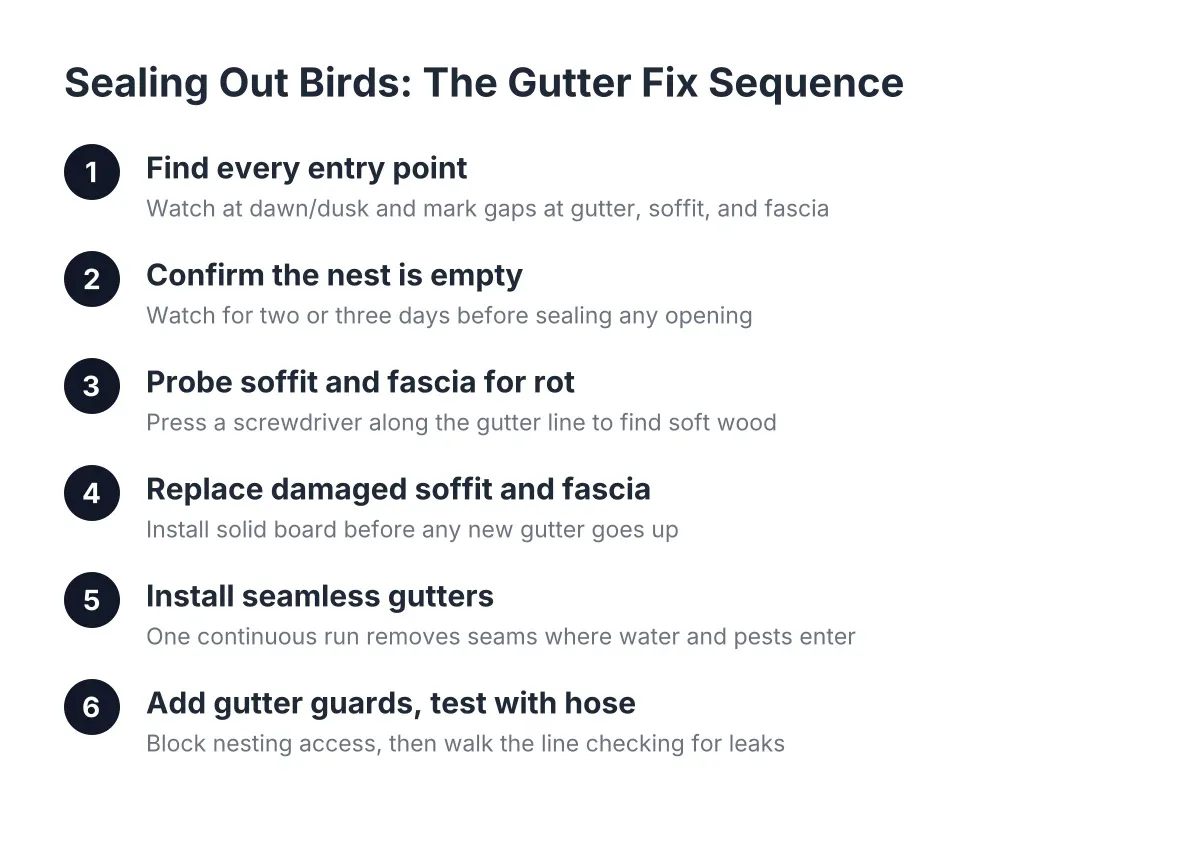
A warranty on gutters does not cover rotted fascia or failing soffit that existed before the job, unless the installer agreed to replace it. This is worth pausing on, because it is the most common gap in storm-repair work. New gutters screwed into soft, water-damaged fascia will pull loose no matter how well the crew hangs them. A careful installer checks the fascia condition first and tells you plainly if soffit and fascia replacement needs to happen before the gutters go up. If an installer skips that conversation, the warranty behind the gutter work matters a lot less, because the failure is already built in.
Gutter Guard Warranties and Workmanship Coverage Deserve Their Own Reading
Gutter guards often carry splashy warranty language, including no-clog promises and lifetime coverage. Read these closely, because guard warranties have their own quirks, especially when it comes to gutter workmanship warranty coverage for the guard installation itself.
First, check what "no clog" actually means. Many guard warranties cover clogs inside the gutter but not debris sitting on top of the guard, which can still block water from entering. Second, check the fastening requirement. Guards that simply snap in or lay on top without screws tend to shift or go missing over time, and once sections are gone, debris pours in through the gaps. A warranty rarely covers a guard section that blew away because it was never mechanically fastened.
Third, and this one catches Orlando homeowners during roof work: some guard styles tuck under the roof shingles. Installing those can void your roofing warranty. Before any guard installation that touches the shingles, check with whoever installed or warranties your roof. A gutter guard warranty is no trade for a voided roof warranty.
Finally, large helmet-style covers that extend past the gutter edge perform well in light rain and on low-pitch roofs. However, in the kind of heavy downpours Central Florida gets all summer, water can shoot straight over the edge of those covers. The warranty may be intact while the product still fails to do its job in your climate. Coverage and performance are not the same thing.
How Warranty Terms Connect to Installation Quality
A warranty is a promise, but the installation itself determines whether you ever need to use it. When you evaluate installers, the details of their process tell you how often their warranty gets tested.
Good crews measure the roofline before fabricating or cutting gutter sections, so each run fits the house instead of being forced into place. On seamless gutter installation, they pre-attach hangers along the run before lifting it, which keeps a long section from flexing and bending out of shape on the way up. Where sections do join, the downstream piece should overlap on top, facing the downspout, so water flows over the seam instead of against it. And before the job wraps, a water test, running water through the full system, reveals any seam or miter that needs more sealing while the crew is still on site.
Ask any installer you are considering how they verify the work before leaving. An installer who tests the system is telling you something about how seriously they take their own workmanship warranty. One who cannot describe their process is telling you something too.
Warranty, Insurance, and Storm Damage: Who Pays for What
If your gutters were damaged in a storm, three different parties might be responsible for different costs, and sorting that out early prevents arguments later.
- Your homeowner's insurance handles storm damage: gutters torn off by wind, crushed by branches, or dented by hail, along with related soffit and fascia storm repair. The installer's role is to document the damage, write a clear scope of work, and do the repair; the claim itself runs between you and your adjuster.
- The installer's workmanship warranty handles installation failures after the new work goes in: a seam that leaks, a run that was pitched wrong, a downspout that detaches in normal weather.
- The manufacturer's warranty handles product defects: a finish that peels or a guard material that fails long before its rated life.
For example, say a homeowner near Orlando has gutters ripped off in a storm, files a claim, and gets a new seamless gutter installation covered by insurance. Six months later, one miter starts dripping during routine afternoon rain. That is not an insurance matter, and it is not a manufacturer defect. It is a workmanship issue, and the installer's labor warranty should cover the fix at no charge. Knowing which bucket a problem falls into tells you who to call and what to expect.
One honest caveat: if your roof also took damage, hold off on gutter work until the roof plan is settled. Replacing a roof after new gutters go in means removing and reinstalling those gutters, which adds labor and cost, and may complicate both warranties. When roof and gutter work happen together, the combined job is usually more cost-effective. A conversation between your roofer and your gutter installer up front saves money and protects both warranties.
Questions to Ask About the Warranty Before You Sign
You do not need to be a contract lawyer to vet gutter warranty terms. Five direct questions cover most of the ground:
- How long is your workmanship warranty, and is it in writing on the contract?
- What exactly does it cover, and what voids it?
- Who handles a manufacturer defect claim, you or me?
- Does the warranty transfer if I sell the house?
- If I add gutter guards later, or have roof work done, does that affect coverage?
Get the answers in writing. A verbal "we stand behind our work" is a nice sentiment, not a warranty. The written terms should name the coverage period, what triggers a covered repair, and how to request service.
Transferability deserves special attention in a market like Orlando, where homes change hands often. A workmanship warranty that transfers to the next owner adds a small but real selling point. One that dies at closing does not.
What Warranty Strength Tells You About Price
Warranty terms also help you read quotes. Gutter installation costs an average of $4 to $40 per linear foot depending on material and gutter type, according to Angi, and seamless gutters typically run $8 to $28 per linear foot on average in the U.S., according to Modernize. Those are wide ranges, and warranty strength is one of the things hiding inside them.
A quote at the bottom of the range with a vague or missing workmanship warranty is not actually cheap; it just moves the risk onto you. Meanwhile, a mid-range quote for gutters backed by a clear, written, multi-year labor warranty prices in the installer's confidence that the job will hold. Gutter length, material choice, roofline complexity, and the condition of the soffit and fascia drive the rest of the price difference. When two quotes sit far apart, the warranty section is one of the first places to look for why.
The Bottom Line on Gutter Warranty Protection
A trustworthy gutter installation warranty has two layers: a manufacturer warranty against product defects and a written workmanship warranty against installation failures. Storm damage belongs to your insurance, maintenance belongs to you, and everything about how the gutters were hung belongs to the installer. Guards add a third layer of fine print, especially around fastening and roof-shingle contact.
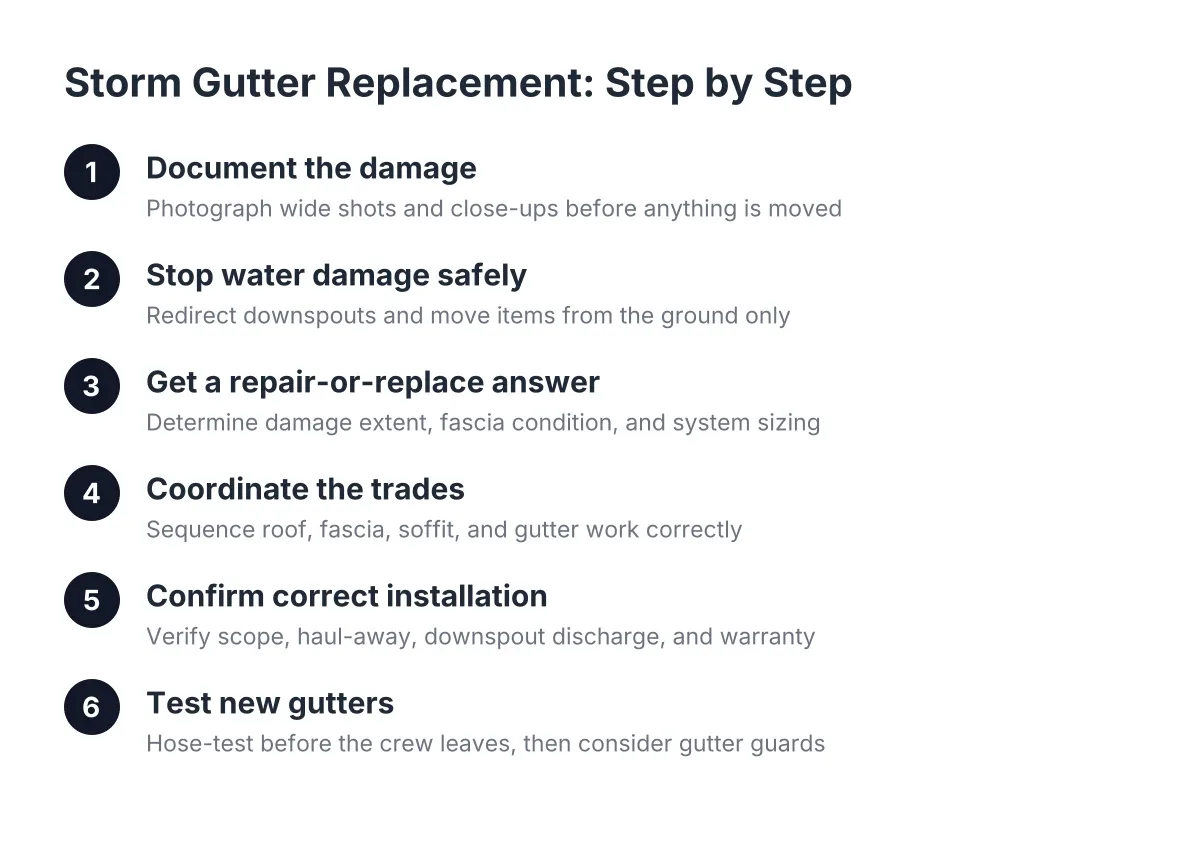
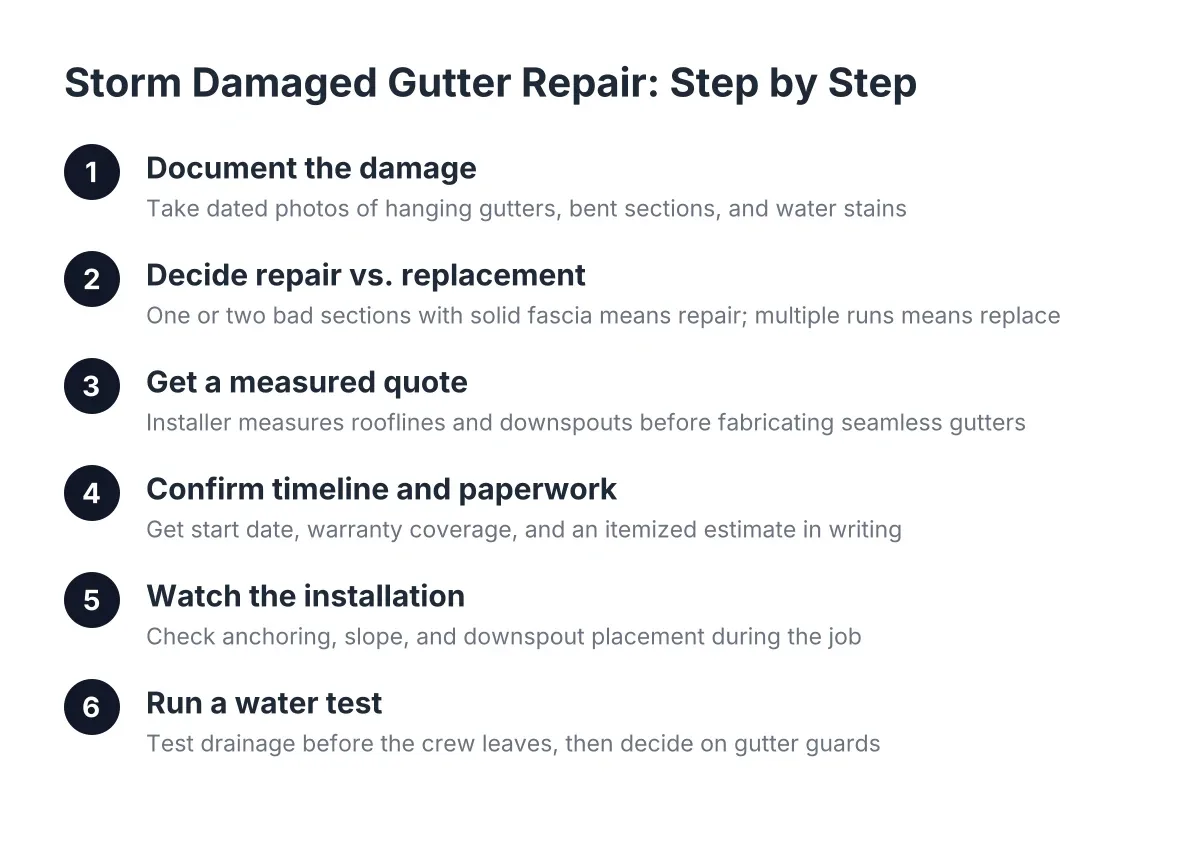
For a storm-damage situation, the practical order of operations is simple. Document the damage, settle the roof question first if the roof was hit, then choose an installer who will put the warranty terms in writing before anyone climbs a ladder. The company that explains what is covered, what is excluded, and why, before you sign, is the same company most likely to pick up the phone when you call about a drip two summers from now.
If you need gutter installation, Orlando Gutter Installers can help.
Prefer to talk it through? Call (689) 399-8982 — a quick call is usually the fastest way to get a straight answer for your situation.