Why Siding, Soffit, Fascia, and Gutters Fail Together and Cost Less Fixed Together
If your gutters overflow every time a summer storm rolls through Orlando, the problem usually does not stop at the gutters. Siding, soffit, fascia, and gutters all share the same edge of your house, and they all take the same water. When one fails, the others start failing right behind it. That is why patching one piece at a time often means paying for the same repair zone twice, or three times. This guide explains why these parts fail together, how to get them repaired together, and how bundling the work into one visit saves money on labor you would otherwise pay more than once. Understanding bundled roofline repair cost is the key to avoiding those repeat expenses.
How Siding, Soffit, Fascia, and Gutters Work as One System
Think of your roofline as a chain. Rain hits the roof, runs to the edge, and drops into the gutters. The gutters carry it to the downspouts, and the downspouts move it away from the foundation. The fascia is the vertical board that the gutters hang on. Additionally, the soffit is the panel underneath the roof overhang, and it vents air into your attic. Furthermore, the siding sits just below all of it.
Every link in that chain protects the next one. When the gutters clog or overflow, water runs behind them and soaks the fascia. A rotted fascia board lets water into the soffit. A failed soffit lets water, and sometimes squirrels or wasps, into the attic. From there, water can run down inside the wall and show up as stained or buckled siding. One clog at the top can end up costing you repairs at every level below it.
This is why so many Orlando homeowners who call about overflowing gutters end up finding soft fascia boards they never noticed. The overflow was the symptom you could see from the driveway. The rot was happening quietly behind the gutter the whole time.
What Is Soffit and What Is Fascia, in Plain Terms
Fascia is the long board that runs along the roof edge, facing outward. If you stand in your yard and look at the trim right under your shingles, that is the fascia. Your gutters are screwed into it, which means a rotted fascia cannot hold a gutter at the right slope, or sometimes at all.
Soffit is the flat material on the underside of the overhang. Look straight up when you stand next to your exterior wall and you will see it. Good soffit is usually vented so your attic can breathe. Soffit panels slide into a channel at the fascia board, so the two parts are physically connected. Damage to one almost always touches the other.
Why Siding, Soffit, Fascia, and Gutters Fail at the Same Time
These four components fail together because they live together. They sit on the same roofline, face the same sun, and catch the same rain. Central Florida's summer thunderstorm pattern dumps heavy water on that edge over and over, and any weak point in the chain spreads damage to its neighbors within a season or two.
Here is the usual failure sequence we see described by homeowners all over Orlando:
- Gutters clog, sag, or are too small for the roof, so water overflows or leaks behind them.
- The fascia board behind the gutter stays wet, and wood fascia starts to rot.
- The rotted fascia can no longer hold gutter hangers, so the gutter pulls away or loses its slope, making the overflow worse.
- Water works into the soffit panels, which stain, sag, or fall open.
- Runoff sheets down the siding below, leaving streaks, swelling, or peeling paint, and water pools near the foundation.
Notice that the sequence is a loop. Bad gutters rot the fascia, and rotted fascia makes the gutters worse. This is why cleaning your gutters three times a year and still watching them waterfall over the sides is a sign the problem is no longer a cleaning problem. The structure the gutters hang on may be failing, or the gutters themselves may be undersized or sloped wrong because the board behind them moved.
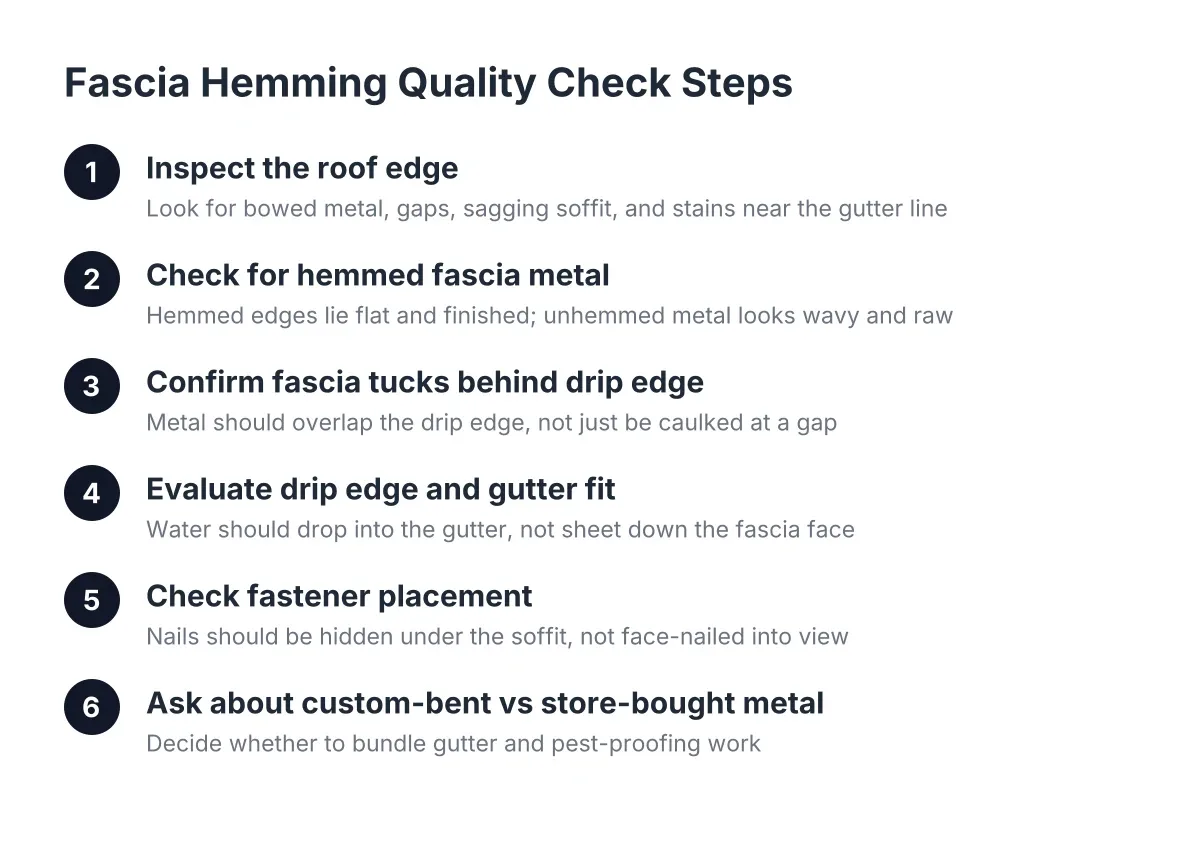
There is one more cause worth naming. Many soffit and fascia failures trace back to how the parts were installed in the first place, not to any storm. Fascia that was face nailed in the field instead of fastened up through the soffit, or soffit panels that were nailed through the face instead of slid into their channel, will open gaps that let water in years before the material itself wears out. A good repair fixes the installation method, not just the board.
Why Bundled Roofline Repair Cost Decreases with a Single Job
Repairing siding, soffit, fascia, and gutters as a single bundled job costs less than hiring for each piece separately because the labor overlaps. To replace a fascia board, the gutter on that run has to come down anyway. If you fix the fascia this month and replace the gutters next spring, you pay someone to remove and rehang gutters twice. Bundle the work and you pay for that step once. Understanding this approach shows why bundling saves significantly.
The overlap goes further than gutter removal:
- One ladder setup and one crew visit instead of two or three separate trips with separate minimum charges.
- The fascia gets inspected and replaced before the new seamless gutters go on, so the new gutters anchor into solid wood from day one.
- Soffit panels get reset or replaced while the fascia is open, since the two connect at the same channel.
- Gutter slope, downspout placement, and downspout extensions get planned around the repaired roofline, not retrofitted around old mistakes.
- You get one person responsible for the whole edge of the house, instead of a gutter company and a trim carpenter pointing at each other when water shows up again.
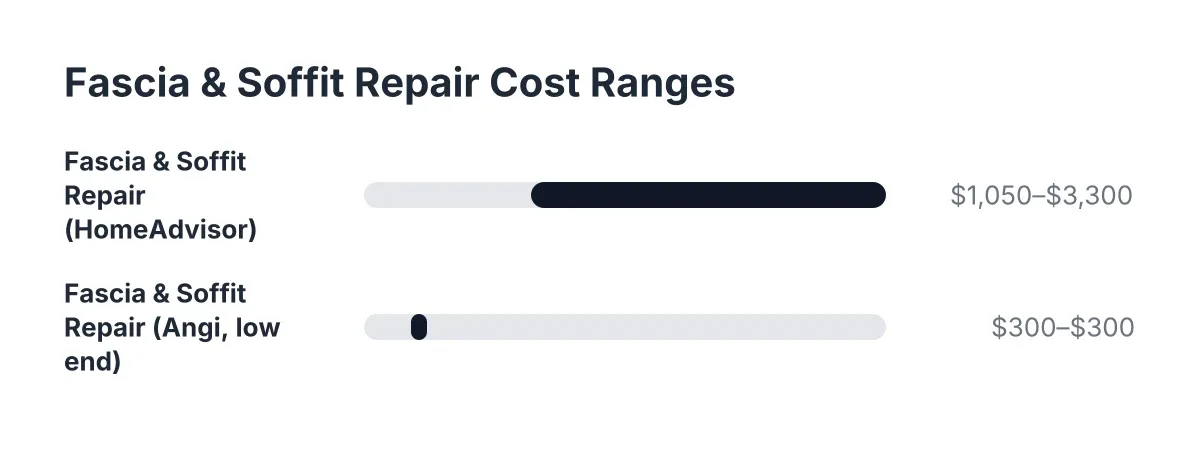
For a sense of scale, HomeAdvisor reports that professional fascia and soffit repair or replacement runs between $1,050 and $3,300 for a home, averaging near $2,500. Angi puts the range wider, from $300 to $7,200 depending on materials and how far the damage has spread, with dry rot repairs running $500 to $4,000. The spread in those numbers is the whole argument for acting early and bundling. A small section of rot caught during a gutter job sits at the bottom of that range. Rot that spread into the soffit and sheathing because the overflow ran for two more years sits at the top.
Per-foot figures tell the same story. This Old House lists soffit replacement at $6 to $30 per linear foot with an average near $17, and fascia board replacement at $7 to $40 per linear foot depending on material, length, and local labor rates. When a crew is already on the ladder replacing fascia, adding the adjacent soffit run costs the material and a modest amount of extra labor. Calling someone back out six months later for that same soffit run means paying the trip and setup all over again.
A Hypothetical Orlando Example of Bundled Roofline Repair Costs
Suppose a homeowner near downtown Orlando has gutters that overflow at the same corner every heavy rain. Say they have paid for gutter cleaning three times this year, and the overflow keeps coming back. An inspection finds the real problems: the gutter run is undersized for that roof section, the fascia behind the corner is soft from years of water leaking behind the gutter, and two soffit panels nearby have started to sag.
In that scenario, the piecemeal path looks like this: another cleaning now, a fascia patch next quarter when the gutter finally pulls loose, a soffit repair after that, and eventually new gutters anyway. Each visit carries its own trip and setup cost, and the old gutters come down and go back up at least once in the middle.
The bundled path is one job. The crew removes the failing gutter run, replaces the rotted fascia and the two soffit panels, then installs new seamless gutters sized for that roof section, with a downspout relocated so water stops dumping at the corner. Same materials in the end, fewer visits, no duplicated removal labor, and the overflow problem is actually diagnosed instead of managed.
How a Bundled Roofline Repair Actually Goes
A combined fascia and soffit repair with new gutters follows a logical order, and knowing it helps you check that any contractor you hire is doing it right. The order matters because each layer supports the next. When homeowners understand how bundled roofline repair cost breaks down across these steps, they can better evaluate contractor bids.
- Inspection and diagnosis. The contractor walks the roofline and probes the fascia for soft spots, checks soffit panels for sag or gaps, and looks at gutter size, slope, and downspout placement. This is where you find out whether your overflow is a clog, a slope problem, undersized gutters, or a failing fascia that let the gutters move.
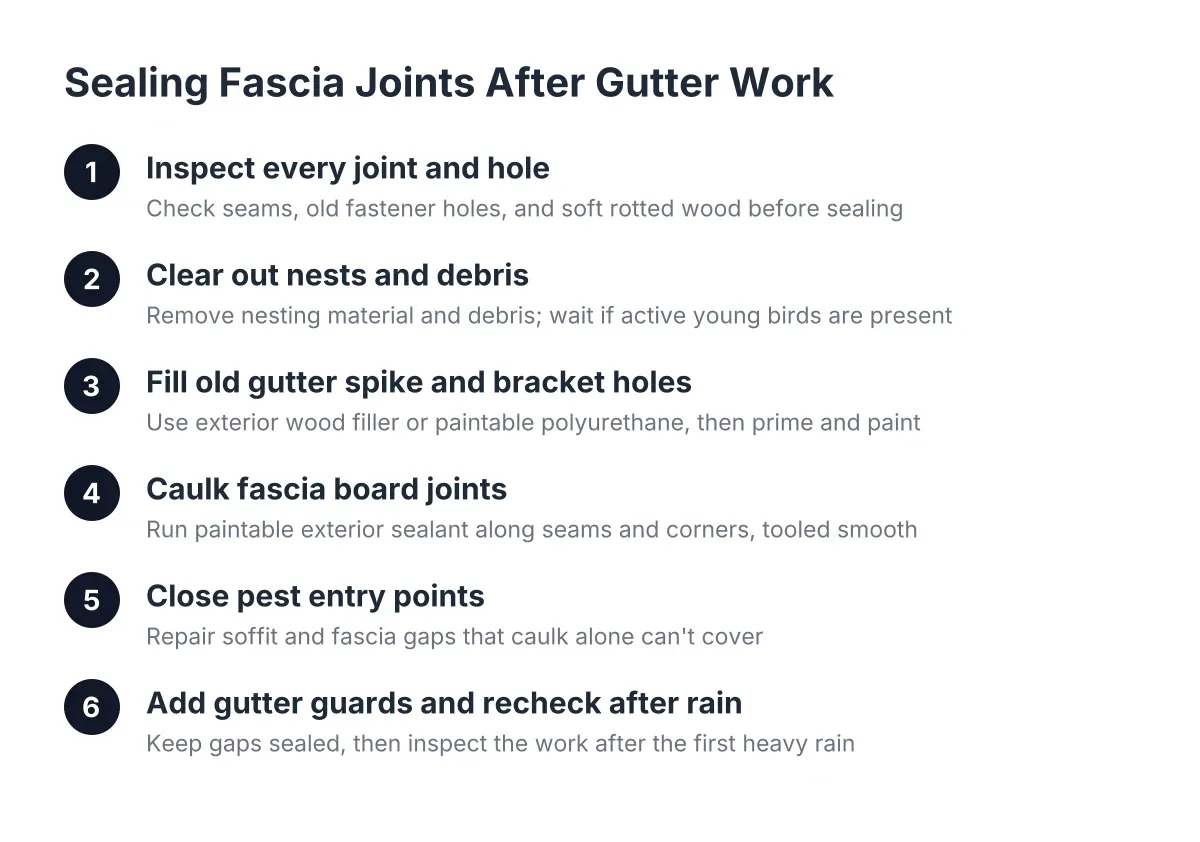
- Gutter removal. Old gutters and downspouts come off the runs being repaired. This exposes the full fascia so nothing gets hidden behind a gutter.
- Fascia replacement. Rotted boards come off and new fascia goes on. Fasteners should go up underneath through the soffit, with face nailing only at seam locations where boards overlap. Fascia nailed through the face everywhere invites the same water intrusion you just paid to fix.
- Soffit repair or replacement. Panels slide into the channel at the new fascia and get secured from the edges, not nailed through the face. Vented panels keep attic airflow working.
- Siding and trim touch-up. Any siding damage below the failure zone gets addressed while the area is open and accessible.
- Seamless gutter installation. New gutters go on last, sized for the roof area, sloped correctly toward downspouts placed where the water should go. Downspout extensions move the discharge away from the foundation and flower beds.
- Optional gutter guards. With the system rebuilt, gutter screens or guards can keep Orlando's oak leaves and pine needles out so you are not back on the cleaning treadmill.
If a roof replacement is on your horizon too, timing matters there as well. Installing new gutters at the same time as a new roof avoids paying to remove and rehang gutters as a separate step, the same bundling logic applied one layer up.
What Drives the Cost Up or Down on a Combined Job
No honest contractor can quote a combined siding, soffit, fascia, and gutter job without seeing the house, but the cost drivers are predictable. Knowing them helps you compare quotes intelligently instead of just comparing bottom-line numbers.
- Linear footage. More roofline means more fascia board, more soffit panel, and more gutter. This is the biggest single driver.
- How far the rot spread. Surface damage on one fascia run is cheap compared to rot that reached the soffit, the sub-fascia, or the roof sheathing.
- Materials. Wood fascia is the budget option but rots again without protection. Aluminum-wrapped fascia and vinyl or aluminum soffit cost more up front and shrug off Florida humidity.
- Roofline complexity. A simple rectangular ranch costs less per foot than a house with multiple gables, corners, and second-story runs that need extra ladder work.
- Gutter sizing and downspouts. Larger gutters, extra downspouts, and downspout extensions add cost, but they are usually the actual fix for chronic overflow.
- Access. Two-story sections, steep grades, and landscaping that blocks ladder placement add labor time.
One honest trade-off to weigh: bundling means a larger single invoice, even though the total across all the work is lower. If your budget only covers one piece right now, fix the fascia and the gutter run above the active leak first, since that stops the water that causes everything else. A professional should also be the one to open up any soffit section where you suspect rot has reached the rafters or there are signs of animal entry; that is not a diagnosis to make from the ground.
Should Gutters Match the Fascia and Soffit?
Gutters do not have to match the fascia and soffit, but a bundled job is the easiest time to coordinate them. Seamless aluminum gutters come in many standard colors, and so do aluminum fascia wrap and soffit panels. Matching the gutter to the fascia makes the gutter visually disappear; matching it to the trim or roof color makes it an accent. When one crew handles the whole roofline, you pick the colors once and everything arrives coordinated, instead of hunting for a gutter color that matches fascia someone else installed last year.
Notes for Rental Property Owners
Small landlords in the Orlando area see this failure chain through a different lens: tenant complaints. A tenant reports overflowing gutters or a sagging soffit panel, and the clock starts. Piecemeal repairs mean multiple appointments the tenant has to accommodate, multiple invoices to track, and the risk that the next heavy rain generates the next complaint before the last invoice is paid.
Bundling the roofline work during a turnover or before listing solves that cleanly. One scheduled job, one scope of work, and a system that handles storm season without generating calls. For owners of two or three rentals, having the same contractor assess the siding, soffit, fascia, and gutters across all units creates a simple picture of which property needs work now and which can wait a year. That turns surprise repairs into planned maintenance, which is where rental margins live.
Gutter guards deserve a hard look on rentals too, since tenants rarely report clogged gutters until water is already overflowing. This Old House's 2025 gutters survey found that 44% of homeowners never clean their gutters at all, and tenants are even less likely to think about it. Screens on a rental are cheap insurance against the clog-overflow-rot cycle starting again on a roofline you just paid to rebuild.
Stop Patching the Symptom, Fix the Chain
If your gutters overflow every storm no matter how often you pay for cleaning, the useful question is no longer who cleans gutters. It is who repairs soffit and fascia and installs gutters as one job. Ask any contractor you call to diagnose the whole chain: gutter size for your roof area, slope, downspout placement, fascia condition behind the gutters, and soffit condition at the overhang. If someone only offers to clean or only offers to rehang the same gutters on soft wood, keep calling.
The roofline fails as a system, and it repairs best as a system. One inspection, one scope, one crew, one invoice, and a corner of your house that finally handles an Orlando thunderstorm the way it should. That is cheaper than the patch-and-repeat cycle in money, and far cheaper in the Saturday mornings you stop spending watching water pour over the side of a gutter you just paid to clean.
If you need soffit and fascia repair, Orlando Gutter Installers can help.
Prefer to talk it through? Call (689) 399-8982 — a quick call is usually the fastest way to get a straight answer for your situation.